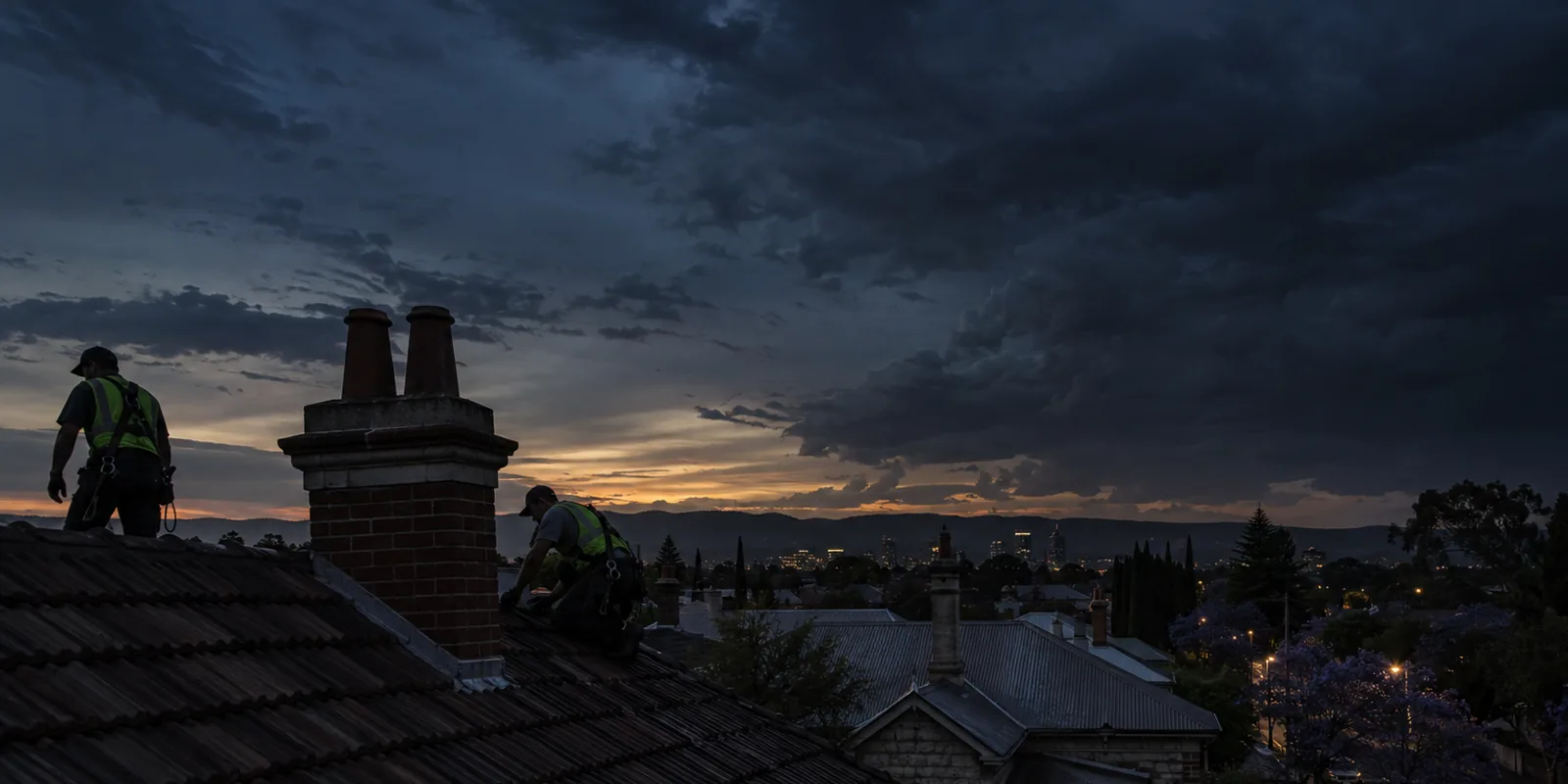
Roofers in Plympton, Adelaide
Plympton lies along Anzac Highway between the city and Glenelg, a flat inner south-western suburb in the City of West Torrens. It mixes interwar bungalows with post-war homes and unit groups, and its position on the plain toward the coast means it gets the leading edge of every south-westerly front.
What usually goes wrong on Plympton roofs
- Ridge and hip mortar crumbling on interwar terracotta bungalows
- Concrete tiles on 1960s homes porous and cracked, with slipped tiles where battens have sagged
- Gutters and downpipes on unit groups blocking and overflowing into adjoining units
- Rusted valley irons under long valleys on bungalow roofs
- Wind-driven rain entering through missing sarking during winter fronts off the gulf
Local notes from the roofers
Plympton is close enough to the coast that the weather arrives before the suburb has time to think about it. Fronts off Gulf St Vincent cross Glenelg and reach these streets in minutes, and the first sign of a roof problem is usually water on a ceiling during the first heavy rain of May. The older streets near Anzac Highway are 1920s bungalows under terracotta tiles with long valleys and cement-pointed ridges, and those valleys are galvanised iron from the same year as the house, rusted from beneath where leaf litter has held moisture. The post-war brick homes and Housing Trust groups toward Marion Road are under concrete tiles that have gone porous, with slipped tiles where a batten has sagged and no sarking to stop wind-driven rain. Unit groups built since the 1970s share gutters and downpipes, and an overflow in one unit's gutter ends up in the next one's ceiling. Salt air is milder here than at Glenelg but still noticeable on old galvanised gutters. Blocks are flat, access is easy, and the clay is the usual reactive plain soil that takes the fall out of gutters.
Housing and roof types in Plympton
1920s and 30s bungalows under terracotta tiles on the older streets near Anzac Highway, 1950s to 60s brick homes under terracotta and concrete tiles, Housing Trust groups from the same era, and a spread of unit developments from the 1970s onward.