Drive through Marion, Modbury or Morphett Vale and most of the roofs you see are concrete tiles laid between the 1960s and the 1980s. They have done their job for decades, but a growing number of Adelaide owners are stripping them and replacing them with Colorbond steel. This guide explains why, what actually changes on the house, what the conversion costs you in trade-offs, and how the job is staged so the house stays dry.
Why Adelaide owners convert tile roofs to metal
Weight. A concrete tile roof is heavy. The frame was built to carry it, but decades of footing movement on Adelaide’s reactive clay have shifted many of those frames slightly, and the load does not help. Colorbond sheeting weighs a small fraction of the tiles it replaces.
Heat. Adelaide summers run well above thirty-five degrees and concrete tiles soak up that heat and release it into the roof space long after sunset. A light-coloured Colorbond roof over a foil blanket reflects more and cools faster in the evening. It is not a substitute for ceiling insulation, but it helps.
Porous tiles. Concrete tiles erode on the surface after thirty to forty years. They absorb water, grow moss and lichen, and get heavier when wet. Once the surface is gone there is nothing for a coating to bond to, and restoration stops being an option.
Ridge mortar. Every ridge and hip on a tiled roof sits on cement mortar that cracks with thermal movement and ground movement. Rebedding and repointing fixes it for a time, but the metal roof removes the problem entirely: ridge capping on a Colorbond roof is screwed metal, not mortar.
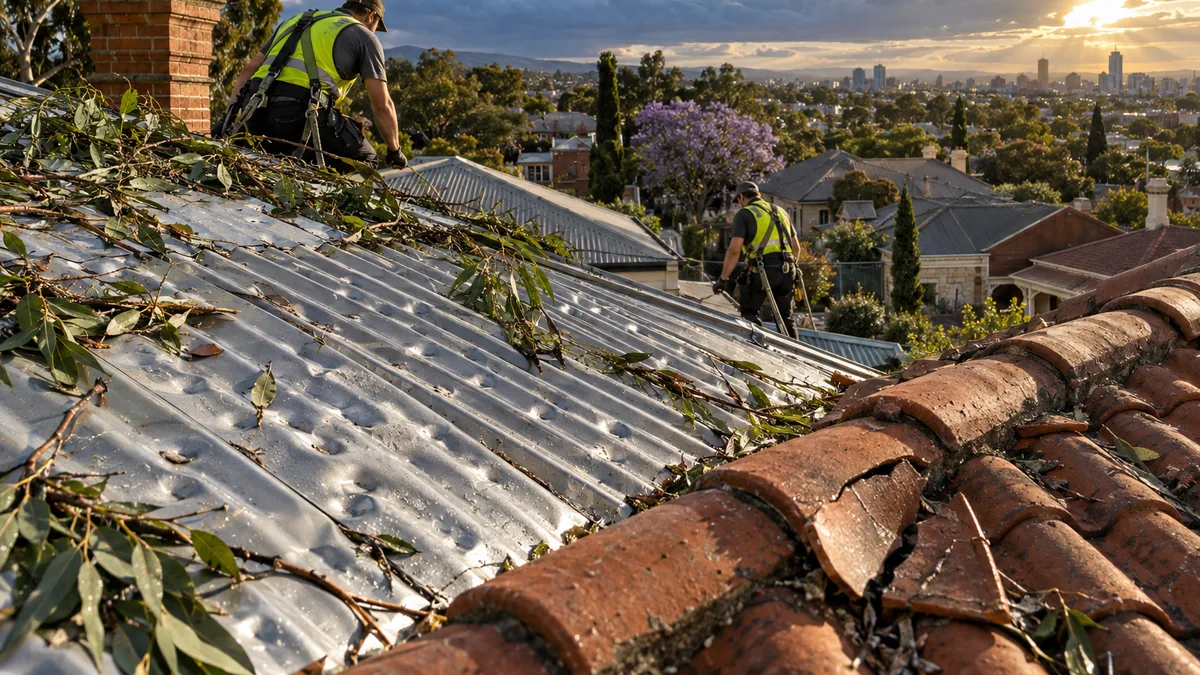
Storms. Spring and autumn storms with gusty northerlies lift loose tiles and dislodged ridge caps, and hail cracks brittle tiles. A properly fixed metal roof with cyclone-rated screws has fewer loose parts to lose.
Leaks that keep coming back. An owner who has paid for repairs three winters running on a roof with failed sarking, rusted valleys and porous tiles often reaches the point where a conversion is the sensible end to the cycle rather than another patch.
What changes on the frame
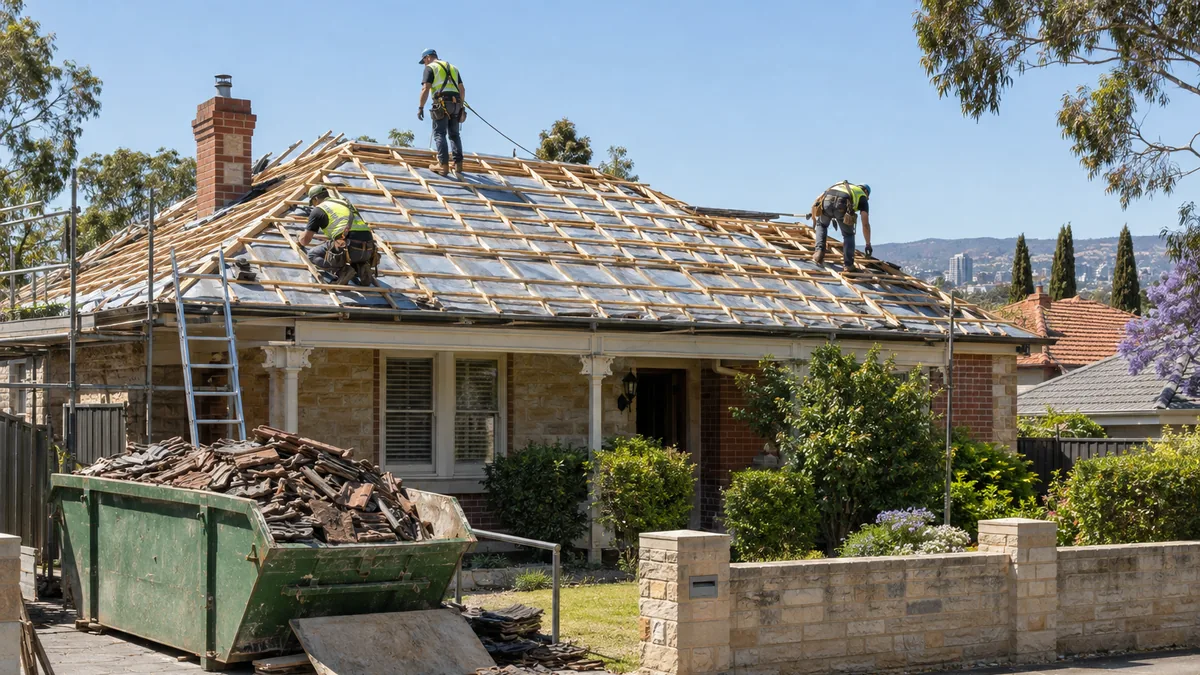
A tile to metal conversion is a re-roofing job, and the frame is where the work starts once the tiles are off.
The existing tile battens are spaced for tiles. Metal sheeting needs battens at a different spacing and, usually, a different section, so the old battens are typically removed and replaced with new timber or steel battens. This is also the point where rotted or borer-affected battens and any rafter damage from long-term leaks are found and fixed.
Because the new roof is so much lighter, the frame rarely needs strengthening. What it does need is checking: the roofer looks at rafters, tie-downs and the connection of the roof frame to the walls, because a lighter roof is more affected by wind uplift than a heavy one, and the fixing schedule for the sheets and battens has to reflect that. On older frames, additional tie-down straps or brackets are sometimes added.
Sarking and insulation
Most 1960s to 80s tiled roofs in Adelaide were built with thin foil sarking or none at all. A conversion is the one chance to get this right. Under a metal roof the standard is a foil-faced insulation blanket laid over the battens before the sheets go down. It does three things: it stops condensation forming on the underside of cold metal on winter nights and dripping into the ceiling, it takes the edge off rain noise, and it adds a reflective layer against summer heat. In the Hills, where nights are colder and rain heavier, the blanket is essential rather than optional.
Ceiling insulation is a separate item. With the roof off it is easy to top up or replace, and worth pricing at the same time.
Pitch considerations
Concrete tiles need a reasonable pitch to shed water. Corrugated Colorbond can be laid at a lower pitch than tiles, and other profiles go lower still, so almost any tiled roof in Adelaide can be converted without changing the pitch. Where a roof has very low sections, such as a later lean-to extension or a verandah tied into the main roof, the roofer will choose a profile suited to that pitch and may run longer sheets without laps to remove a leak point. What you cannot do is put a low-pitch profile on a steep roof and expect it to look right, so profile choice follows the roof, not the catalogue.
Appearance, colour and heritage areas
Metal changes the look of a house. On a 1970s brick veneer in Golden Grove or Happy Valley, a Colorbond roof in a muted colour reads as a modern update and suits the surrounding estate roofs that were built in steel from the 2000s onwards. On a cream brick 1960s home the change is more noticeable, and colour choice matters.
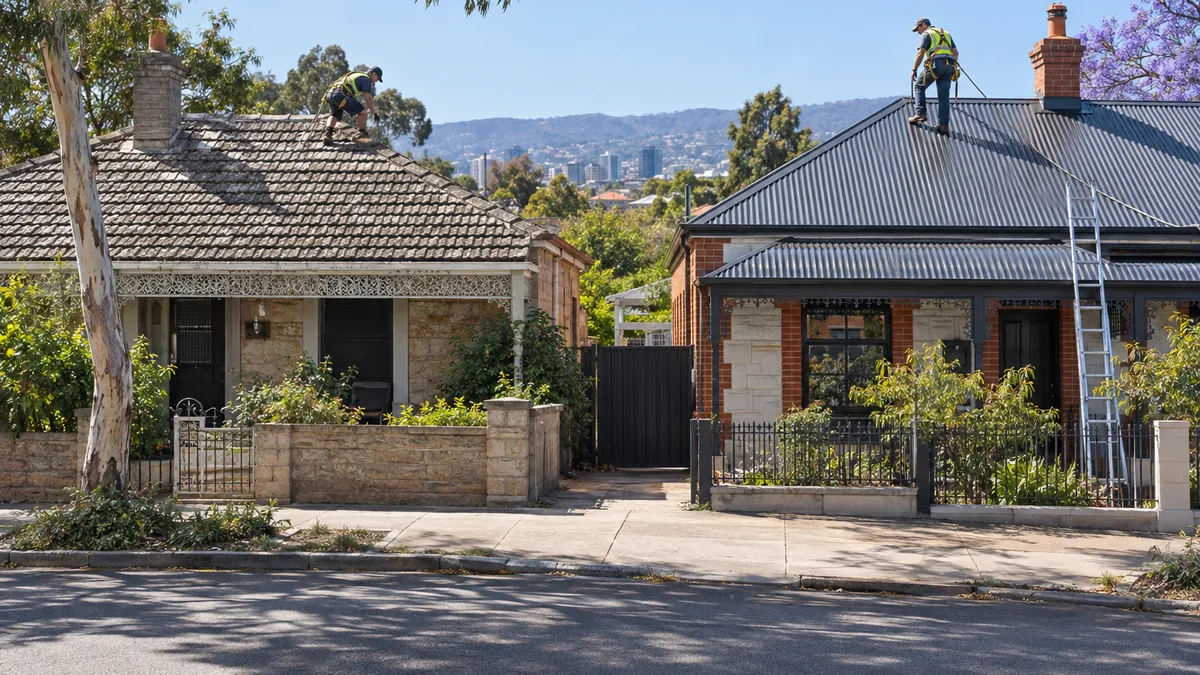
In the inner and eastern suburbs the situation reverses. Bluestone and sandstone villas in North Adelaide, Unley and Norwood were built under corrugated galvanised iron. Many were tiled over in the middle of last century, and for those homes a conversion back to corrugated iron in Colorbond or Zincalume is a return to the original look, not a departure from it. Heritage and character zones may still limit profile, colour and verandah detail on the street frontage, and the roofer should check with the council before quoting. The Inner Adelaide area page covers the housing stock in more detail.
Gutters, downpipes and fascia at the same time
The old gutters come off to strip the roof, and they are almost never worth refitting. New gutters and downpipes are sized to the roof area and set to fall, and any rotted timber fascia is replaced before the new gutter goes on. On a metal roof the gutter has to cope with faster run-off than a tiled roof in a heavy downpour, so the downpipe count and position are checked, not simply copied from the old layout. See the gutter repairs page for what a properly set gutter looks like.
Solar panels
If the house has solar, the panels have to come off before the tiles and go back on after the sheets are down. That is electrical and installer work, not roofing, and it needs to be coordinated. The upside is that the new mounts are flashed into a new roof by the roofer rather than screwed through old tiles, which is one of the common leak sources on Adelaide roofs. If you are planning solar, doing it after the conversion avoids a second lot of penetrations later.
The drawbacks, honestly
Rain noise. Metal is louder than tile in heavy rain. A foil blanket and ceiling insulation reduce it a great deal, but a roof without a blanket will be noisy, and some people notice it even with one.
Condensation. Without a blanket, moisture condenses on the underside of the sheets on cold nights and drips. This is the main reason a conversion done cheaply, without the blanket, leads to complaints about a leaking roof that has no leak.
Colour fade and chalking. All painted steel fades over time, faster on the northern and western faces that take the afternoon sun, and faster again near the coast. Choose a colour with that in mind and accept that the roof will soften in tone over the years.
Coastal corrosion. Within a few streets of Gulf St Vincent at Glenelg, Henley Beach, Grange and Semaphore, salt air attacks unprotected metal. A coastal-grade product, correct fasteners and regular fresh-water washing of areas the rain does not reach make the difference between a roof that lasts and one that rusts at the laps. The metal roof repairs page explains what fails on coastal roofs.
Dents from hail. Large hail will dent a steel roof where it would crack a tile. The dent is cosmetic on a properly fixed roof, but it is visible.
Timing and staging
A conversion runs in stages: solar down if present, gutters off, tiles stripped and skipped, battens replaced, blanket laid, sheets fixed, flashings and ridge capping fitted, gutters and downpipes on, solar back up. The roof is stripped and re-covered in sections so the house is never open overnight, with tarps on hand for a change in the weather.
Adelaide’s dry, settled weather from late spring through summer is the easiest window, with early starts on hot days. Winter is possible but slower, because a south-westerly front can hold a crew off the roof for days. Whatever the season, the sequence is the same: the roof is inspected, the quote is written and itemised, and nothing starts until you approve it. The roof replacement cost guide explains what each line of that quote is likely to contain.
Questions on this topic
Q. Does the roof frame need strengthening for a tile to metal conversion?
Rarely. Colorbond sheeting weighs a small fraction of the concrete tiles it replaces, so the frame that carried the tiles will carry the steel. What the frame does need is checking and re-battening: metal sheets need battens at a different spacing, and a lighter roof is more affected by wind uplift, so the roofer looks at rafters, tie-downs and the connection to the walls and may add straps or brackets where the fixing schedule requires it.
Q. Is a metal roof noisy in the rain?
Louder than tile, yes. A foil-faced insulation blanket laid over the battens under the sheets reduces the noise a great deal, and ceiling insulation reduces it further. A conversion done without the blanket will be noisy and will also suffer condensation dripping from the underside of the sheets on cold nights. Ask for the blanket to be listed on the quote rather than treated as an optional extra.
Q. Can I convert to Colorbond in a heritage or character zone?
Often, and in the inner and eastern suburbs it can be a return to the original look. Bluestone and sandstone villas in North Adelaide, Unley and Norwood were built under corrugated galvanised iron and many were tiled over later. Heritage and character zones may still limit the profile, colour and verandah detail visible from the street, so the roofer should check the council requirements before quoting.
Q. What happens to my solar panels during a roof conversion?
They come off before the tiles are stripped and go back on after the sheets are fixed. That is electrical and installer work rather than roofing, and it has to be coordinated with the roofer. The benefit is that the new mounts are flashed into a new roof properly instead of being screwed through old tiles, which is one of the common leak sources on Adelaide roofs. If solar is planned rather than installed, fit it after the conversion.
Q. Does the pitch of my roof need to change?
Almost never. Corrugated Colorbond can be laid at a lower pitch than concrete tiles, and other profiles go lower still, so a roof that carried tiles can carry steel at the same pitch. Where a roof has low sections such as a lean-to extension or a verandah tied into the main roof, the roofer chooses a profile suited to that pitch and may run longer sheets without laps to remove a leak point.
- tile to metal
- roof conversion
- Colorbond
- re-roofing
- concrete tiles
- heritage