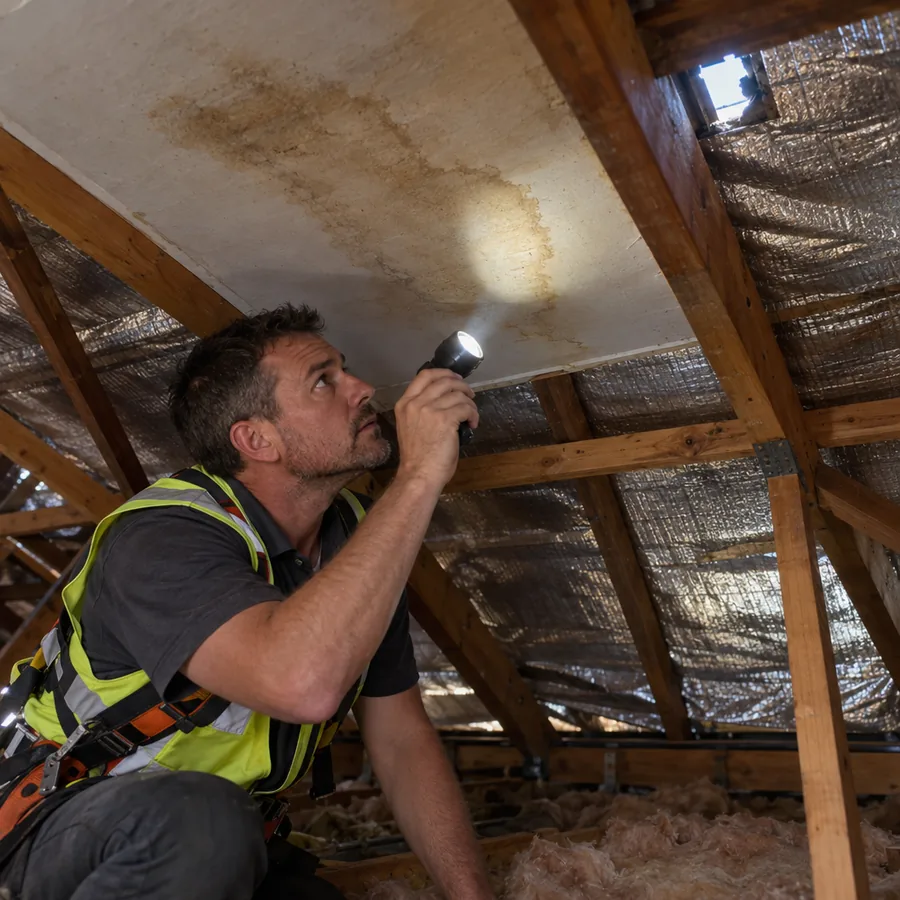
A great many of the ceiling stains reported in Adelaide every winter are not roof leaks at all. They are gutters. A gutter that is rusted, blocked or has lost its fall fills in the first heavy south-westerly front of June, spills backwards over its rear edge, and runs under the eaves and onto the ceiling. This page covers what fails on Adelaide gutters and downpipes, the box gutters on villas and parapet homes, where the water is supposed to go, gutter guard in the Hills, fascia repairs, and why all of it is licensed roof plumbing in South Australia.
Why gutters fail in Adelaide
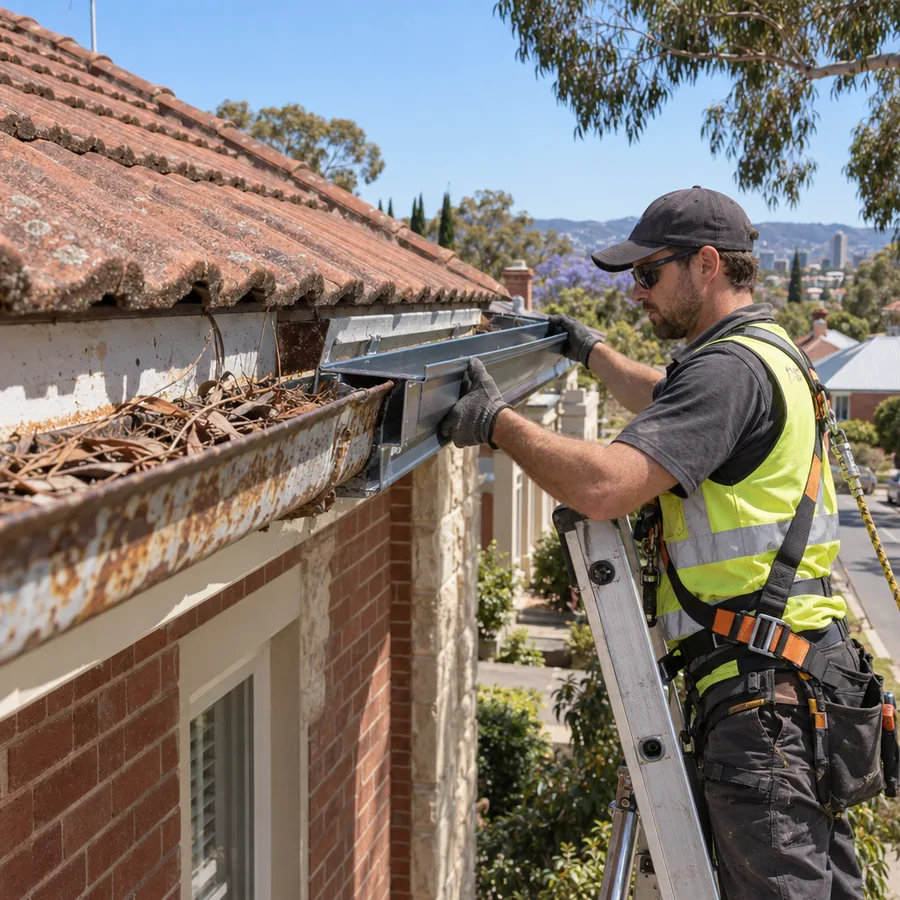
Rust is the first cause. Gutters hold water and debris longer than any other part of the roof, and a galvanised or early Colorbond gutter rusts from the inside, at the joints and along the back edge where wet leaves sit against the fascia. Near the coast, in Glenelg, Henley Beach, Semaphore and Port Adelaide, salt air takes years off the life of every gutter and downpipe.
Fall is the second. A gutter is supposed to run downhill to the downpipe. On many Adelaide homes it no longer does. The brackets sag, the fascia they were screwed to has softened, or the reactive clay under the house has moved the footings and the frame enough to put a dip in the run. Water sits in the dip, the gutter rusts there first, and in heavy rain it overflows at the lowest point rather than reaching the outlet.
Blockage is the third. Leaves, gum nuts, tennis balls, moss washed off the tiles and the grit that erodes from old concrete tiles collect in the gutter and at the downpipe head. In the Hills, stringybarks and deciduous trees fill a gutter in a season.
Overflow back under the eaves
The failure that matters most is water going the wrong way. A gutter with a blocked outlet, a rusted back edge or no fall rises in heavy rain until it spills. If the front edge is lower than the back, it spills harmlessly onto the ground. If the back edge is lower, or the gutter is fitted tight against the fascia with no overflow, it goes backwards over the rear edge, under the eaves lining and into the roof space. The first sign is a stain on the eaves or a damp patch on the ceiling near an external wall, and the owner assumes the roof is leaking.
The fix is clearing and re-setting the gutter to fall, replacing the rusted sections, and making sure the gutter has overflow provision so that a future blockage spills outward. The roof leak repairs page explains how a gutter overflow is told apart from a genuine roof leak before anything is quoted.
Box gutters on villas and parapet homes
The bluestone and sandstone villas of Unley, Norwood, North Adelaide, Prospect and Parkside were built with parapet walls, and the roof drains into a box gutter running between the parapets or behind the front wall. New townhouses and apartments across the inner suburbs and the coast use the same idea behind a flat facade. A box gutter is wide, flat-bottomed and has very little fall, and it is the single most troublesome piece of roof plumbing on an Adelaide house.
Leaves collect in it because there is nowhere else for them to go. It rusts because water sits in it. When the outlet blocks, the water has no outside edge to spill over, so it rises and goes into the ceiling. On a heritage villa the box gutter may be the original galvanised iron with a century of patching.
Box gutter work means clearing and inspecting the run, relining it or replacing it in Colorbond or another suitable material, fitting a sump at the outlet, and adding an overflow that discharges outside the building so that the next blockage shows on the wall rather than on the ceiling. It is skilled roof plumbing and it is quoted as its own line.
Downpipes and stormwater
Downpipes carry the water from the gutter outlet to the ground, and from there it should run through stormwater pipes to the council stormwater system at the boundary. On a lot of older Adelaide homes it does not. The downpipe stops a hand-span above the ground and dumps every millimetre of rain beside the footings. On the reactive clay of the Adelaide plain that is a slow disaster: the clay swells, the footings move, the brickwork cracks, and the roof frame shifts enough to open flashings and crack ridge pointing.
Downpipe work covers replacing rusted or crushed pipes, adding downpipes where a long gutter run has too few, and connecting them to the stormwater drain properly. The council owns the drain in the street; everything on your side of the boundary is yours, and the quote itemises what is needed.
Gutter cleaning and gutter guard in the Hills
Stirling, Aldgate, Crafers, Belair and Blackwood sit under stringybarks, pines and the deciduous trees planted a century ago, and gutters there fill several times a year. The Hills also get more rain than the plains, so a full gutter overflows sooner and more often. Gutter cleaning before winter is the minimum. Gutter guard fitted to suit the gutter profile and the roof type reduces how often it needs doing.
In bushfire-prone areas with a Bushfire Attack Level requirement, gutter guard is also about embers. Ember guard mesh of the specified material and aperture stops embers lodging in a gutter full of dry leaves, which is one of the ways houses are lost. The mesh has to be non-combustible and fitted correctly to the gutter and the roof edge, and it still needs to be checked each year.
Fascia repairs
The fascia is the board along the roof edge that the gutter brackets screw into. On older homes it is timber, and when a gutter has been overflowing backwards for a few winters the fascia behind it rots. A soft fascia will not hold a bracket, so new gutters sag within a year. Fascia repair or replacement, in timber or in a Colorbond fascia system, is done before the new gutter goes on, and the eaves lining is checked for water damage at the same time.
Colorbond gutter replacement and re-roofing
When a gutter run has rusted along its length, or has been patched at every joint, replacement is the honest answer. The old gutter comes off, the fascia is repaired, new brackets are fitted to fall, and new Colorbond gutter in the profile that suits the house goes on with new downpipes where needed. Colours are chosen from the manufacturer’s range to match the roof or the trim.
If the roof itself is at the end of its life, gutters are almost always replaced as part of re-roofing, because the roof edge is disturbed anyway and new sheeting deserves new gutters. The re-roofing page covers that job, and a tile-to-metal conversion in particular usually comes with a full gutter and downpipe replacement.
Why gutter work is licensed roof plumbing
In South Australia, gutters, downpipes, box gutters, flashings and metal roof sheeting are roof plumbing, which is licensed plumbing work under the Plumbers, Gas Fitters and Electricians Act 1995. The contractor also needs a Building Work Contractors Licence from Consumer and Business Services. You can check both on the CBS public register, and you are entitled to ask for the licence number before the work starts. Work at the gutter line is done from ladders, edge protection or scaffold as South Australian work health and safety rules require.
Storm damage to gutters
Gutters and downpipes torn off by wind or crushed by a fallen branch are common after the spring and autumn fronts, and they are the sort of sudden damage home insurance generally covers, unlike rust and wear. The emergency roof repairs page explains make-safe work and the written report insurers ask for, and the blog post on storm and hail damage and insurance walks through the claim.
The inspection and the quote
The roof plumber inspects every run of gutter, each downpipe and where it discharges, the box gutters and their overflows, and the fascia and eaves. You receive a written, itemised quote that separates repair from replacement and lists gutter guard, downpipes, fascia and stormwater connection as their own lines. Manufacturer warranties apply to the products used, the workmanship warranty is stated in writing on the quote, and nothing starts until you approve it.
What is included
- Inspection of gutters, downpipes, box gutters, fascia and the eaves lining beneath, with photos
- Repair or replacement of rusted or split gutter sections, or full Colorbond gutter replacement
- Gutters re-set to fall correctly to the downpipes, with new brackets where the old ones have let go
- Box gutter repairs, relining or replacement on villas, parapet homes and townhouses, with overflows
- New or repaired downpipes, and a check of the connection to the stormwater system
- Gutter cleaning and gutter guard fitted for leaf litter and ember protection
- Fascia repair or replacement where rotten timber will no longer hold a bracket
- Written, itemised quote before any work starts
Signs you should call
- Water pouring over the front of the gutter in heavy rain instead of reaching the downpipe
- Rust holes, weeping joints or a brown drip line on the paving under the gutter
- Gutters holding water days after rain, or visibly sagging between brackets
- Damp or stained eaves lining, or a ceiling stain near an external wall
- A box gutter that fills with leaves and overflows into the roof space
- Downpipes that are disconnected at the bottom, rusted through or discharging beside the footings
- Fascia boards that are soft, flaking or pulling away from the rafters
Gutter work is licensed roof plumbing in South Australia
Gutters, downpipes, box gutters and flashings are roof plumbing, which is licensed plumbing work under the Plumbers, Gas Fitters and Electricians Act 1995, and the contractor also needs a Building Work Contractors Licence from Consumer and Business Services. You can check both on the CBS public register and ask for the licence number before work starts. Work at the gutter line is done with ladders, edge protection or scaffold as South Australian work health and safety rules require.
Frequently asked questions
Q. Why do my gutters overflow back into the ceiling?
A gutter that is blocked, rusted through at the back, or has lost its fall holds water instead of sending it to the downpipe. In heavy rain that water rises, and if the gutter sits high against the fascia with no overflow, it goes backwards over the rear edge, under the eaves lining and onto the ceiling. Box gutters do the same thing when the outlet blocks. The fix is clearing and re-setting the gutter to fall, repairing the rusted back edge, and adding overflow provision so a blockage spills outward rather than inward.
Q. Is gutter replacement licensed work in South Australia?
Yes. Gutters, downpipes, box gutters and flashings are roof plumbing, which is licensed plumbing work in South Australia, and a roofing contractor also needs a Building Work Contractors Licence from Consumer and Business Services. You can check a licence on the CBS public register and you are entitled to ask for the number before work starts. A general handyman replacing gutters is working outside the licence.
Q. What is a box gutter and why do they cause so much trouble?
A box gutter is a wide, flat-bottomed gutter that sits inside the roof line rather than on the outside edge, typically between two roof planes or behind a parapet wall. The villas of Unley, Norwood and North Adelaide have them between the parapets, and new townhouses and apartments have them behind the front wall. They collect leaves, they rust, they have very little fall, and when they block the only place the water can go is into the ceiling. A properly designed box gutter has a sump, an overflow that discharges outside, and a lining in good condition.
Q. Do I need gutter guard in the Adelaide Hills?
In Stirling, Aldgate, Belair and Blackwood, stringybarks and introduced deciduous trees fill gutters several times a year, and a full gutter overflows in the first heavy rain of winter. Gutter guard reduces how often gutters need clearing. In bushfire-prone areas with a Bushfire Attack Level requirement, ember guard mesh of the specified material and aperture is also part of ember protection for the roof. The mesh must suit the gutter profile and the roof type, and it still needs checking each year.
Q. Can gutters be replaced without replacing the roof?
Yes. Gutter replacement is a stand-alone job on most homes: the old gutter comes off, the fascia is checked and repaired, new brackets go on to fall, and new Colorbond gutter is fitted with new downpipes where needed. If the roof is being re-roofed, the gutters are almost always replaced at the same time because the old gutter is disturbed anyway, but a sound roof does not need to come off for new gutters.
Q. Who is responsible for the downpipe connection to the stormwater?
The downpipes, the stormwater pipes across your property and the connection to the council stormwater system at the boundary are the owner's responsibility; the drain in the street belongs to the council. Downpipes that stop above ground and dump water beside the footings feed the reactive clay under much of Adelaide, which then swells, moves the footings and cracks brickwork. Connecting them properly is part of the job, and the quote itemises it.
Q. How often should gutters be cleaned in Adelaide?
It depends on the trees. A house in Mawson Lakes with no trees might go a long time between cleans; a house under gums in Belair or Athelstone can fill in a season. The rule of thumb is to check before winter, when most of Adelaide's rain falls from May to September, and again after the autumn leaf drop. A blocked gutter in the first big front of winter is the most common cause of the ceiling stains reported every June.