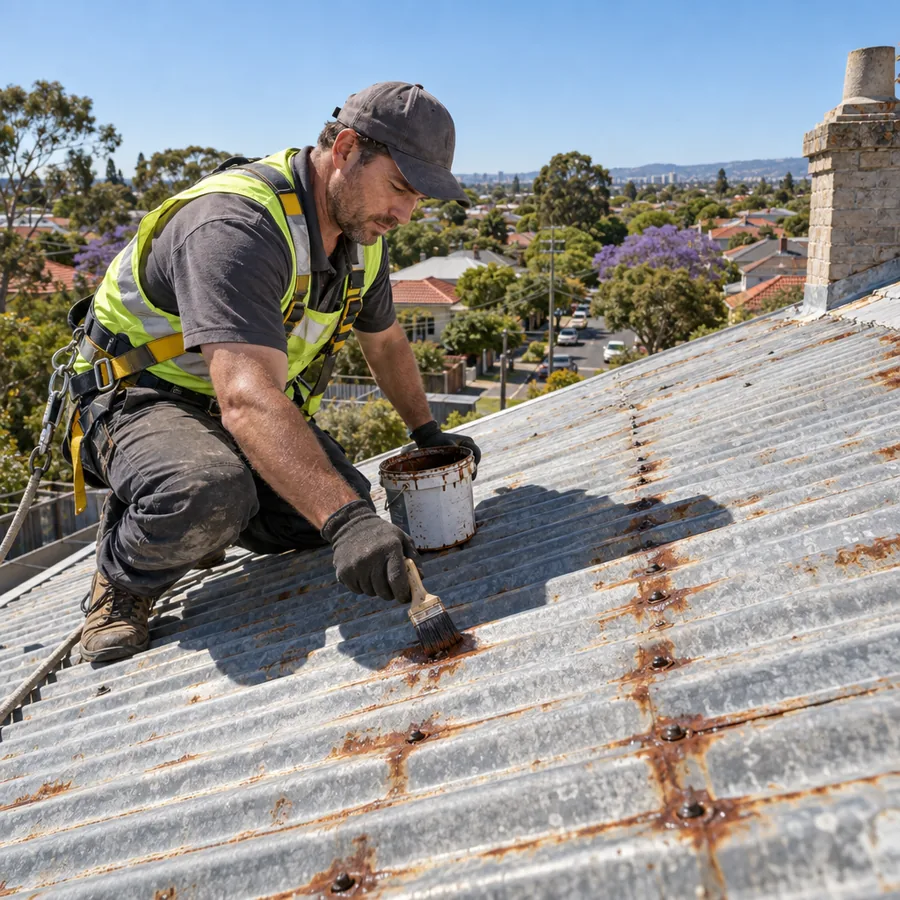
Metal roofs are everywhere in Adelaide, from the short galvanised sheets on a bluestone villa in North Adelaide to the long-run Colorbond on a Mawson Lakes estate home and the big steel roofs on sheds in the Hills. They fail in predictable ways here, and most of those failures are fixable without a new roof. This page covers what goes wrong with iron, Zincalume and Colorbond roofs in Adelaide, how the repairs are done, when a full metal roof restoration is the better answer, and what to expect from the inspection and the quote.
Why metal roofs fail in Adelaide
The Adelaide climate is hard on steel. Summer days above 35 degrees, and heatwaves above 40, heat a roof until every sheet has grown a few millimetres. Winter nights pull it back. Each cycle moves the screws in their holes, works the seals under the screw heads and flexes the laps between sheets. Over a couple of decades the screws lose their bite and back out, the seals perish, and rain gets in around the screw heads. That is the single most common fault on Adelaide metal roofs, and it shows up as rust streaks running down the sheets.
Wind does the rest. Gusty northerlies ahead of a cool change, and the south-westerly fronts that come across Gulf St Vincent in winter and spring, get under a sheet that has already lost half its screws and lift it. A sheet drumming in the wind is a sheet about to go, and once it goes the sheets around it are exposed.
The reactive clay under much of the Adelaide plain adds a slower kind of movement. As the soil swells in winter and shrinks in summer the frame shifts slightly, and on an older roof that opens gaps at flashings and roof-to-wall junctions that were once tight.
Corrugated galvanised iron on villas and cottages
The 1880s to 1930s villas, cottages and bungalows of Unley, Norwood, Prospect, Parkside and North Adelaide were roofed in short sheets of corrugated galvanised iron, nailed to hardwood battens with lead-head nails, with lead flashings at the chimneys and box gutters between the parapets. Many of those roofs are still on, and many have been replaced sheet by sheet over the years so that one roof carries three generations of iron.
What fails on these roofs is the lap between the short sheets, where water sits and rust starts; the nail holes, which enlarge as the nails work loose; the lead flashings, which fatigue and crack after decades of heat; and the box gutters, which rust, block and overflow into the ceiling. Repairs on a heritage roof mean refixing with screws where nails have failed, replacing individual sheets in a matching corrugated profile, remaking flashings and relining or replacing the box gutter. Where the front of the house sits in a heritage or character zone the appearance from the street matters, which is one reason so many villas that reach the end of the road with their iron are re-roofed in corrugated Colorbond rather than a different profile. The re-roofing page covers that decision.
Zincalume and Colorbond roofs
From the 1980s onward Adelaide homes were increasingly roofed in Zincalume and Colorbond, and from the 2000s the estates in Mawson Lakes, Golden Grove, the Gawler corridor and Mount Barker are almost all Colorbond. These roofs are screw-fixed, long-run and far more weathertight than old iron, but they are not maintenance free. Early Colorbond and Zincalume roofs are now old enough for the screws to be the weak point. Cut edges that were never sealed rust from the edge inward. Swarf, the metal filings left when sheets were cut on site, rusts into the surface and leaves spots that look like the sheet is failing when it is not. Hail in a spring storm leaves dents that are usually cosmetic but sometimes crack the coating and start corrosion.
Flashings are the other common fault. Every skylight, whirlybird, aerial, evaporative cooler and solar mount is a hole in the roof, and each one depends on a flashing that was done correctly and has stayed sealed. Solar installations in particular have left a lot of Adelaide roofs with bracket penetrations that leak.
Salt corrosion along the coast
Glenelg, Henley Beach, Grange, Semaphore, Largs Bay and West Lakes sit in a salt environment that shortens the life of every unprotected piece of metal. Salt settles on the sheltered side of the roof and under the eaves where rain does not rinse it, and it goes to work on screw heads, cut edges, mismatched fasteners and any scratch in the coating. Gutters and downpipes go first, then the laps and the gutter edge of the sheets. A roof in Semaphore can need screws and edge repairs a decade before the same roof in Burnside.
Coastal repairs use fasteners and flashings suited to a marine environment, seal cut edges, and pay attention to the leeward side of the roof where the salt sits. If you are near the coast and the roof is showing rust at the laps, it is worth having it looked at before winter rather than after.
Rust at laps and around penetrations
Water sits at the overlap between sheets, at the lower edge where the sheet meets the gutter, and against every penetration. Those are the places rust takes hold. Surface rust on a sound sheet can be treated with a rust converter, primed and coated. Rust that has perforated the sheet cannot be sealed over. The section is cut out and replaced, or the whole sheet is replaced if the rust runs its length. A previous owner’s silicone smeared over a rusted lap is a sign the leak has been there a long time, and it comes off before any real repair.
Sheet replacement or full metal roof restoration
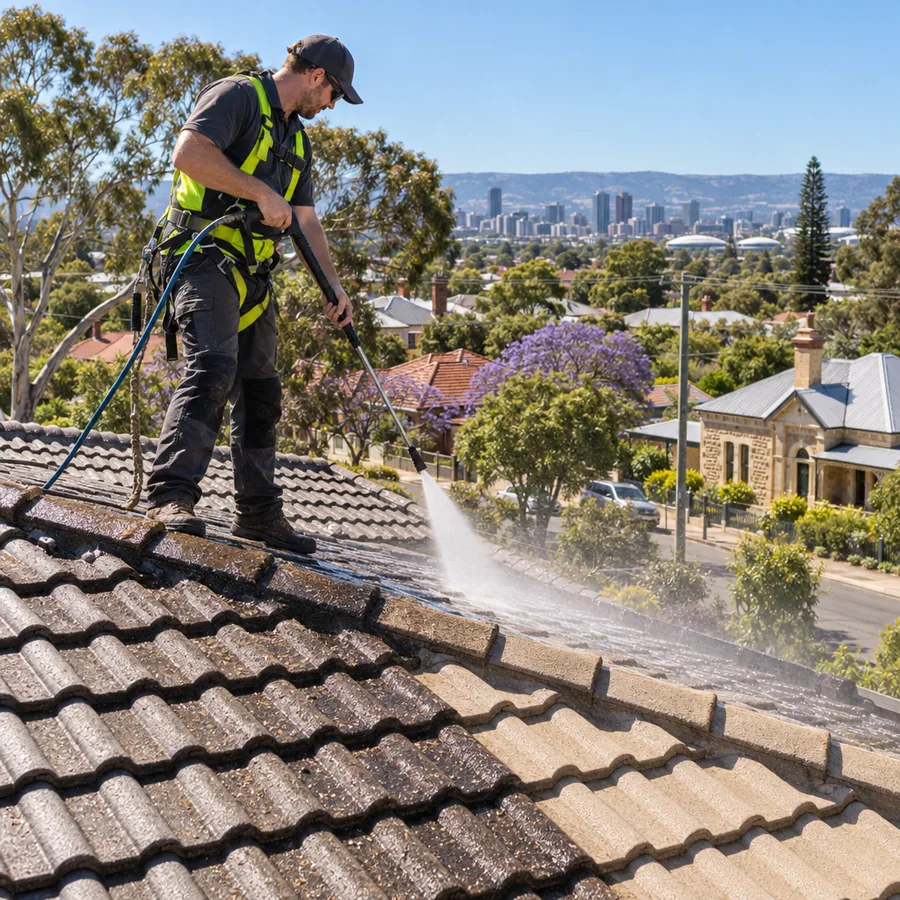
If the faults are local, they are repaired locally: a run of screws, two lifted sheets, one flashing. If the whole roof has weathered evenly, with screws backing out everywhere, surface rust across the sheets and a coating that has chalked away, a metal roof restoration is the better spend. The roof is pressure cleaned, every screw replaced, rust treated, laps sealed, flashings renewed, then primed and coated with a roof membrane in the colour you choose. The result looks and performs like a new roof at a fraction of the cost of re-roofing. The roof restoration page explains the full process, and the blog post on roof restoration cost in Adelaide explains what drives the quote.
When the sheets themselves are rusted through in many places, restoration is money wasted, and re-roofing is the honest answer. The inspection tells you which case applies, and the quote states it in writing.
Flashings and box gutters
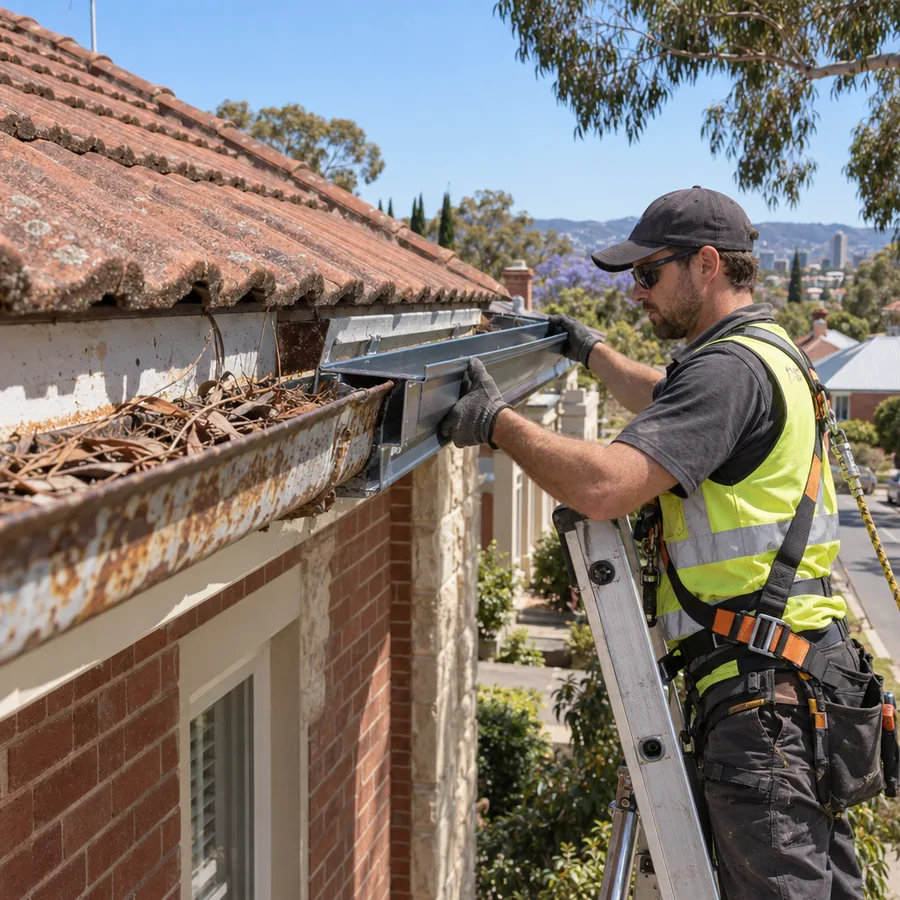
Metal roof sheeting, flashings, gutters, downpipes and box gutters are roof plumbing, which is licensed plumbing work in South Australia. A roofer working on your metal roof should hold both a Building Work Contractors Licence from Consumer and Business Services and the roof plumbing licence, and you can check both on the CBS public register. Flashings are remade in the correct material for the roof, box gutters are relined or replaced with the right fall and overflow, and gutter and downpipe work is covered on the gutter repairs page.
The inspection and the quote
The roofer inspects the whole roof, photographs the faults, and gives you a written, itemised quote that separates the repairs that stop water from the ones that are worth doing while the roofer is there. Manufacturer warranties apply to the products used, and the roofer’s workmanship warranty is stated in writing on the quote. Nothing starts until you approve it. If a lifted sheet is letting water in right now, the emergency roof repairs page explains how make-safe work is handled first.
What is included
- Roof-level inspection of every sheet, lap, screw line, flashing and penetration, with photos of what is found
- Replacement of rusted or backed-out screws with new roofing screws and seals, driven to the correct depth
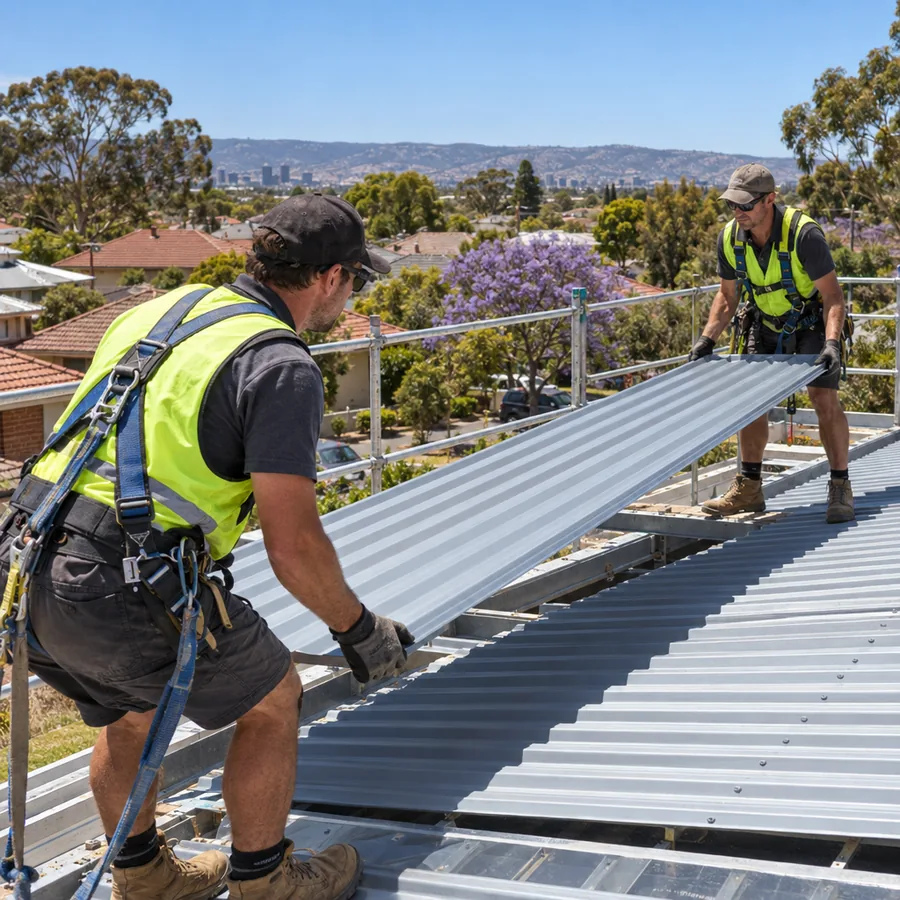
- Refixing or replacement of sheets lifted by wind, with the battens or purlins beneath checked for split or rotten timber
- Cutting out and replacing sheets rusted through at laps, gutter edges and around penetrations
- Rust treatment, lap sealing, primer and roof coating as a full metal roof restoration where the sheets are sound
- New flashings around chimneys, skylights, whirlybirds, solar mounts and roof-to-wall junctions
- Box gutter and gutter repairs or replacement done as licensed roof plumbing at the same visit
- Written, itemised quote before any work starts, with the workmanship warranty stated on the quote
Signs you should call
- Rust streaks running down the sheets from screw heads, or screws standing proud of the roof
- A sheet drumming or flapping in a northerly, or a corner of the roof visibly lifted
- Drips in the ceiling during heavy rain with wind behind it, especially near the lower edge of the roof
- White or red rust at the overlap between sheets, at the gutter edge or around a chimney or skylight
- Sagging or ponding on a low-pitch section, verandah or lean-to
- Sealant smeared over screws and laps by a previous owner that has cracked and let go
- Hail dents on a Colorbond roof after a spring or autumn storm
Do not walk an old metal roof to check it yourself
Rusted galvanised sheets can look solid and give way underfoot, translucent skylight panels will not hold a person, and a roof that is damp with morning dew or sea air is slippery. Roofers use edge protection, harnesses or scaffold as required under South Australian work health and safety rules. If you want to see the problem, look from the ground, from a neighbour's yard or at the photos the roofer takes.
Frequently asked questions
Q. Why do screws back out of a metal roof in Adelaide?
Steel sheeting expands on a 40 degree day and contracts on a cold winter night, and every screw moves a fraction with it. Over thousands of cycles the screw hole in the batten or purlin wears, the screw loses its grip and lifts, and the rubber seal under the head perishes. Once the head sits proud, rain gets past the seal, the screw rusts and streaks the roof, and the sheet is only held down by the screws around it. The fix is a new screw with a fresh seal, or a longer or larger-gauge screw where the timber has worn.
Q. Can a rusted metal roof be repaired, or does it need replacing?
It depends on where the rust is and how deep it goes. Surface rust on an otherwise sound sheet can be treated, primed and coated. Rust that has eaten through at a lap, at the gutter edge or around a penetration is dealt with by cutting out and replacing that sheet or section. When most sheets are perforated, or the roof has been patched so many times that the patches are the problem, re-roofing in new Colorbond is the honest recommendation. The inspection tells you which case you are in, and the quote puts it in writing.
Q. What is the difference between metal roof repairs and metal roof restoration?
Repairs fix specific faults: a lifted sheet, a run of rusted screws, a failed flashing. Restoration treats the whole roof as one job: every screw replaced, all rust treated, laps sealed, flashings renewed, then the roof primed and coated. Restoration suits a roof where the sheets are structurally sound but the surface has weathered, which is common on 1980s and 1990s Colorbond and on older galvanised iron that has never been coated. It is not the right answer for a roof with sheets rusted through.
Q. How does salt air affect metal roofs near Glenelg, Semaphore and Henley Beach?
Salt carried inland from Gulf St Vincent settles on roofs and is not always washed off by rain, especially on the sheltered side of a roof and under eaves. It attacks cut edges, screw heads, fasteners of a different metal to the sheet, and any spot where the protective coating has been scratched. Roofs within a few streets of the coast rust at the laps and gutter edge years before an identical roof in the eastern suburbs. Coastal roofs benefit from screws and flashings rated for marine environments and from a rinse of the sheltered areas from time to time.
Q. Can the corrugated iron on a heritage villa be repaired rather than replaced?
Often, yes. The short galvanised sheets on a North Adelaide, Unley or Norwood villa can be refixed, individual sheets replaced, laps resealed and lead flashings renewed without touching the rest of the roof. Where the street frontage sits under a heritage or character overlay, the profile and appearance of the roof matters, and a like-for-like corrugated profile in a compatible finish is the usual approach. If the whole roof has reached the end of its life, replacing it in corrugated Colorbond keeps the look while giving you a modern, screw-fixed roof.
Q. Is Colorbond roof repair licensed work in South Australia?
Yes. Metal roof sheeting, flashings, gutters, downpipes and box gutters are roof plumbing, which is licensed plumbing work in South Australia under the Plumbers, Gas Fitters and Electricians Act 1995, and roofing contractors also need a Building Work Contractors Licence from Consumer and Business Services. You can check a licence on the CBS public register and you are entitled to ask for the licence number before work starts. A handyman sealing screws with silicone is not a repair.
Q. Can a metal roof be repaired with solar panels on it?
Usually. Screws, laps and flashings around the array can be worked on from the sides, and panels can be temporarily lifted where a sheet under them needs replacing, which is coordinated so the system is safely isolated. Solar mounts are also a common cause of leaks on metal roofs when the bracket penetrations were not flashed or sealed correctly at installation, so they are checked as part of the inspection.