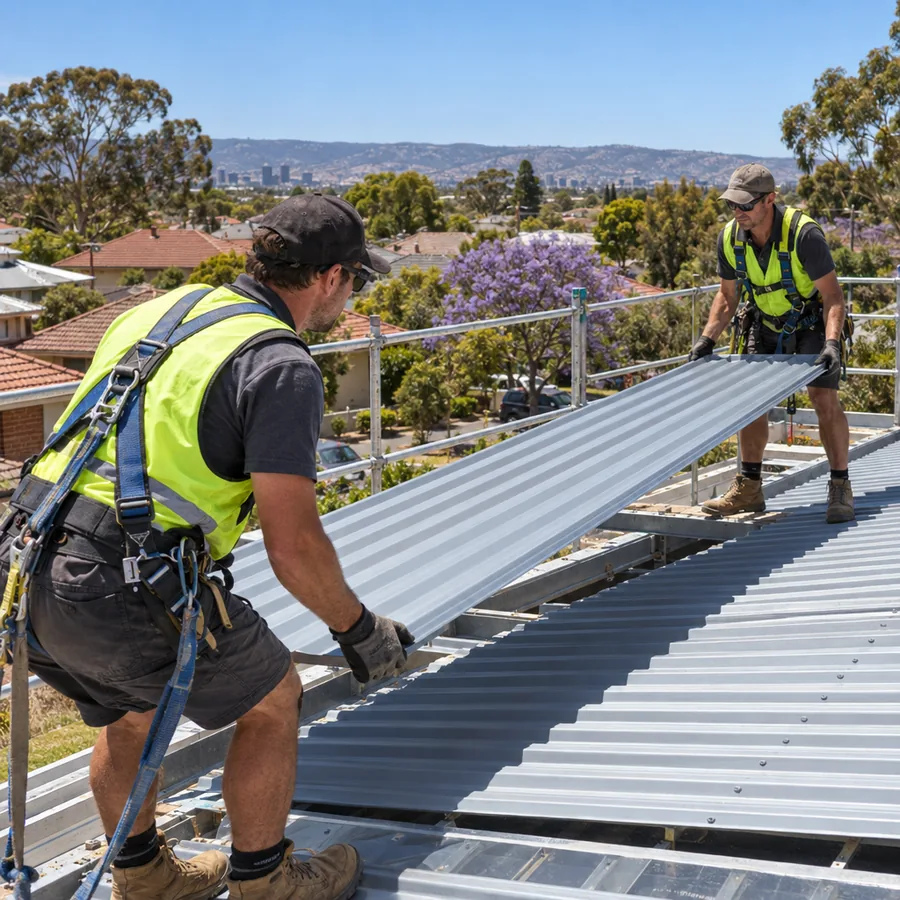
Re-roofing is what most Adelaide homeowners actually need when they say the roof is finished. The frame is straight, the rafters are sound, but the covering on top, whether 1970s concrete tiles or 1950s galvanised iron, has reached the end. Re-roofing strips that covering and fits a new one on the existing frame, with new battens, new sarking and usually new gutters. This page explains how re-roofing differs from a full replacement, why tile to Colorbond conversions are so common on 1960s to 1980s homes, how heritage villas are returned to corrugated iron, what is checked on the frame, how the job is staged so the house is never open overnight, and how it is timed around Adelaide’s weather.
What re-roofing means
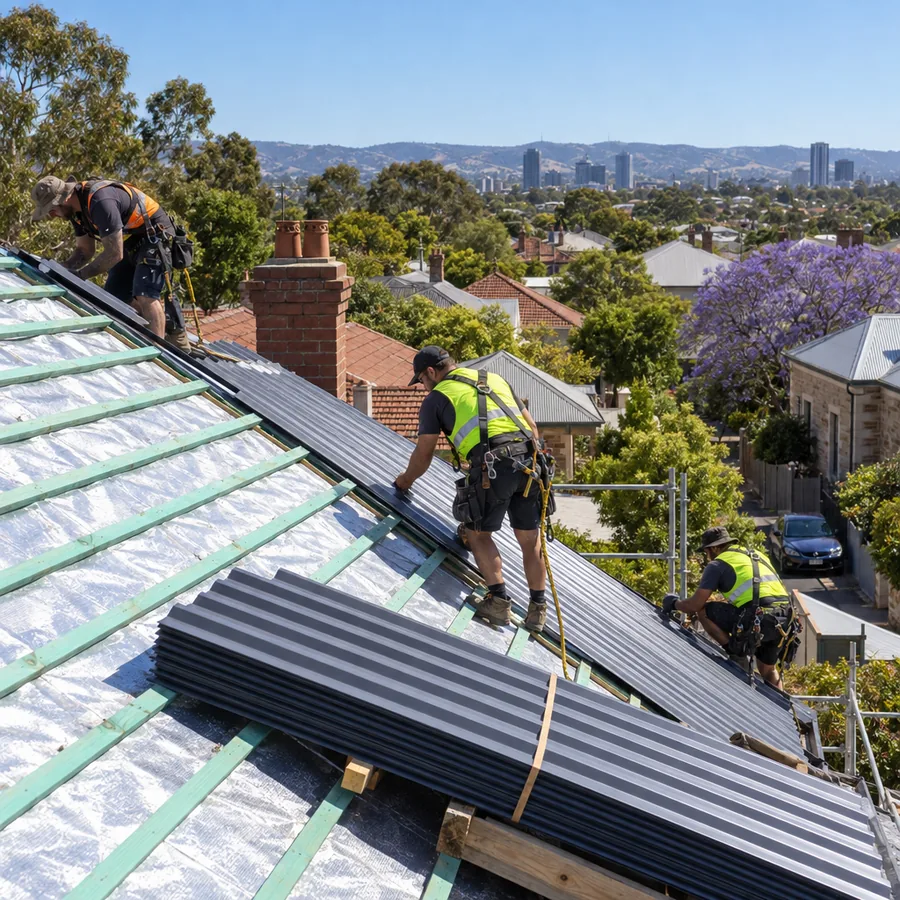
A re-roof keeps the structure and replaces everything above it. The old tiles or sheets come off, the old battens usually come off with them, the frame is inspected, new battens go on at the spacing the new covering needs, new sarking or an insulation blanket is laid, and the new roof is fitted with new ridge capping, valleys, barge cappings and flashings.
A full roof replacement goes further when it has to, with rafter repairs, new fascia, and frame work where the structure has been damaged by long-term leaks or rot. In practice the two overlap, and the inspection decides which the quote describes. Most 1960s to 1990s brick and brick veneer homes in Adelaide have sound timber frames and are re-roofed rather than rebuilt.
Tile to Colorbond conversions on 1960s to 80s homes
The concrete tile roofs on the brick veneers of Modbury, Golden Grove, Happy Valley, Morphett Vale, Magill and Campbelltown are now forty to sixty years old. Many are porous across the whole roof, patched with mismatched tiles, leaking at the ridges and valleys, and brittle enough that every visit from a solar or antenna tradie breaks a few more. Owners replacing them increasingly choose Colorbond steel rather than new tiles, which is why tile to metal is the most requested re-roof in Adelaide.
The reasons are practical. Steel is a fraction of the weight of tiles, so the frame is relieved rather than loaded. It goes on faster, so the house is exposed for less time. It works at a lower pitch than tiles, which suits the shallow roofs of the 1970s. It sheds leaf litter and does not grow moss the way porous concrete does. It takes a solar array on rail mounts with proper flashings rather than brackets under brittle tiles. And it changes the look of the house, which for a dated brick veneer is often the point.
The blog post on tile to metal roof conversions covers what changes in detail, including the gutter and fascia work where the tile overhang used to sit.
Returning heritage villas to corrugated iron
The other common re-roof is at the opposite end of the housing stock. The bluestone and sandstone villas and cottages of North Adelaide, Prospect, Unley, Norwood and Port Adelaide were built under corrugated galvanised iron between the 1880s and the 1920s. Over the decades many were patched with odd sheets, some had the original iron replaced with a profile that does not match, and the lead flashings, box gutters and parapet cappings have fatigued and rusted.
Re-roofing a villa means new corrugated Colorbond or Zincalume in the traditional profile, new box gutters between the parapets and behind the verandah, new lead or compatible flashings at the chimneys and parapet walls, and the bullnose verandah roof done at the same time where it has rusted. Heritage and character zones in these suburbs generally expect the street-facing roof to keep its corrugated profile, and the roofer raises the council question before quoting rather than after.
Weight, frame and batten checks
Before quoting, the roofer looks at the frame from the ceiling space, and again from above once the first section is stripped. Rafters and ridge boards are checked for sag, splits, rot around old leaks and borer. On a tile to metal conversion the frame is being asked to carry less than before, so strengthening is rarely needed, but battens must be replaced with the size and spacing the sheeting requires, and tie-downs are fitted so the lighter roof is held against the gusty northerlies that arrive ahead of a change.
Going the other way, from iron to tiles, adds a great deal of weight and normally needs an engineer’s confirmation that the frame can carry it. Any frame repair the inspection finds is written into the quote before the job starts, not discovered mid-job and added on.
Sarking and insulation upgrade
Most Adelaide roofs built before the 1990s have no sarking, or sarking that has shredded. Sarking is the reflective foil or membrane laid over the battens under the roof covering. It catches wind-driven rain that gets under tiles or laps, stops dust, and reflects summer heat. A re-roof is the one time it can be fitted properly across the whole roof.
On a metal re-roof an insulation blanket is normally laid under the sheets as well. It cuts the noise of rain on steel, reduces condensation dripping off the underside of the sheets on cold nights, and adds to whatever ceiling insulation is already there. Ceiling insulation can be topped up while the roof is off, which is worth doing on any home that bakes in February.
How the job is staged and how long the house is exposed
The house is not left open. Work is planned in sections that can be stripped, battened, sarked and covered in one day, so that at the end of each day the roof is weatherproof. On a typical single-storey home that is a matter of days rather than weeks, though the exact timing depends on the roof area, the number of hips and valleys, access and the weather.
Edge protection, harness anchors or scaffold are set up as required under SA work health and safety rules, and a skip is placed for the old tiles or sheets. The ceiling space takes some dust and debris during the strip, so anything stored up there should be covered or moved. Solar panels are disconnected and removed by an electrician before the strip and refitted with proper flashings afterwards.
Timing around Adelaide weather
Most of Adelaide’s rain falls from May to September in fronts that cross Gulf St Vincent, and spring and autumn bring the strongest winds. Re-roofing can be done through winter in dry spells, but it is easier to plan in the drier months and the roofer will watch the forecast day to day. On days above 40 degrees work starts early and stops early for the crew’s safety. In the Hills, from Blackwood up to Stirling and Mount Barker, the wetter and cooler season is longer, and bushfire-prone properties are re-roofed to the Bushfire Attack Level requirements that apply to them, including ember-resistant gutter and ridge details.
Gutters, downpipes and solar
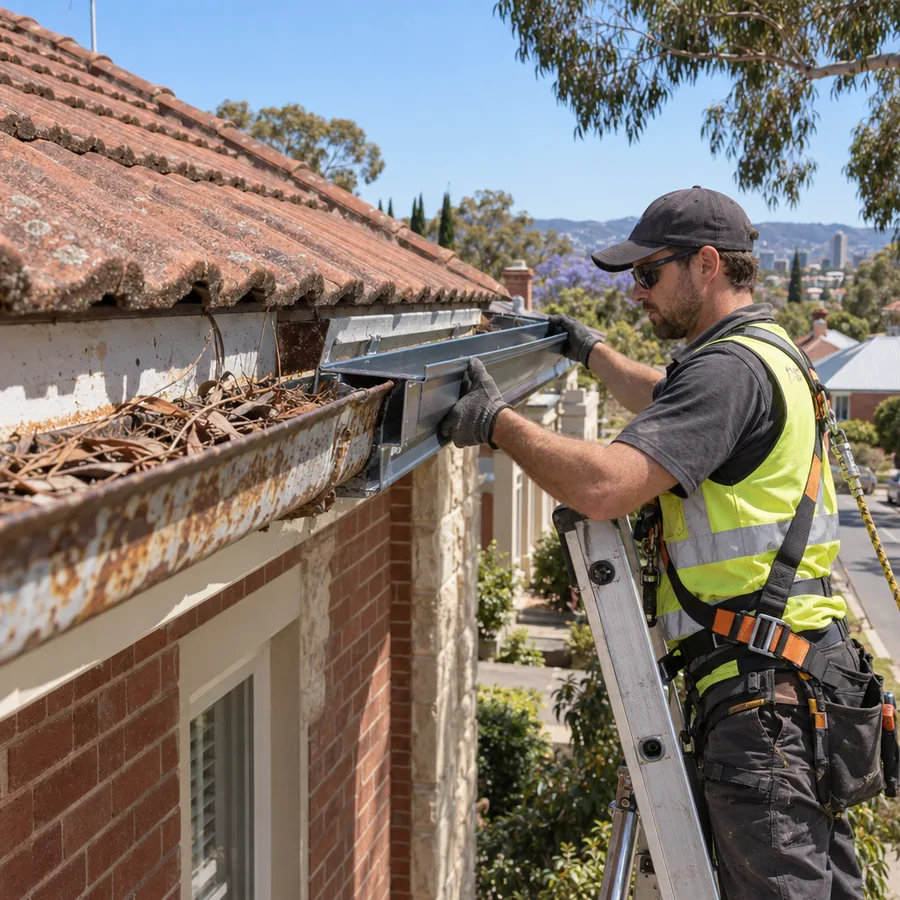
Gutters and downpipes are almost always replaced during a re-roof. The old ones are usually rusted and out of fall, and the new roof’s edge detail is designed to the new gutter profile. The gutter repairs page covers box gutters and downpipe sizing where the existing ones overflow. Solar panels go back on with rail mounts flashed into the new sheeting, which removes the most common source of leaks on tiled roofs with solar. Where the old covering is asbestos cement, as on some 1950s and 60s Housing Trust homes, a licensed asbestos removalist regulated by SafeWork SA does the strip before the roofer takes over.
Licensing and the written contract
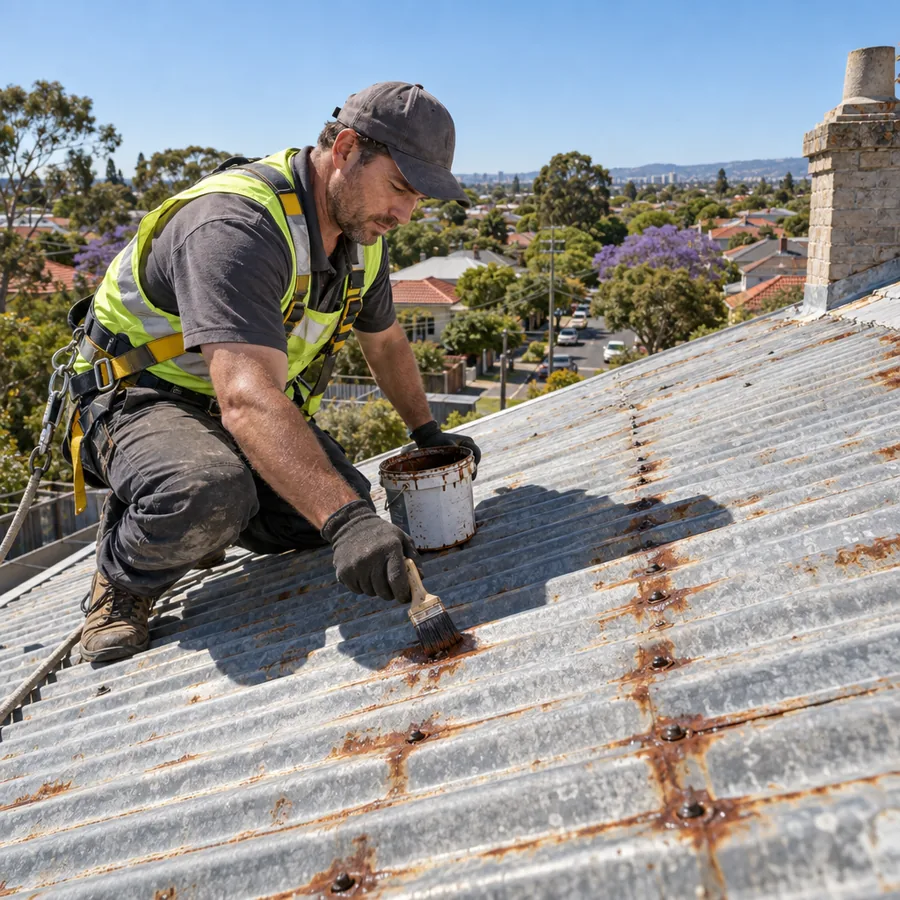
Roofing in South Australia is building work under Consumer and Business Services, and metal roof sheeting, gutters, downpipes and flashings are licensed roof plumbing work. Ask for the roofer’s Building Work Contractors Licence number and check it on the CBS public register. A re-roof is normally a written-contract job under the Building Work Contractors Act, and the contract sets out the scope, the staging, the price and the workmanship warranty. Manufacturer warranties apply to the steel or tiles. The quote is itemised, and nothing starts until you approve it. If the sheets on an existing metal roof are only surface rusted rather than perforated, the metal roof repairs page explains the cheaper alternative.
What is included
- Inspection of the frame, battens and sarking to confirm re-roofing suits the house
- Removal and disposal of the old tiles or sheets, with licensed asbestos removal if the old roof is asbestos cement
- Frame check, with any strengthening or repair written into the quote rather than discovered mid-job
- New battens at the correct spacing and new sarking or insulation blanket
- New Colorbond steel sheeting or new tiles, with new ridge capping, valleys and flashings
- Gutters and downpipes replaced where they are rusted or out of fall
- Work staged in sections so the house is weatherproof at the end of every day
- Final check of every fixing and flashing, gutters flushed and site cleared
Signs you should call
- A 1960s to 1980s concrete tile roof that is porous, cracking and constantly needing tiles replaced
- You want the lighter, cleaner look of Colorbond on a tiled home
- A heritage villa under mismatched sheets that you want returned to corrugated iron
- Sarking missing or shredded, with dust and wind-blown rain reaching the ceiling
- A roof that leaks in a new place every winter despite repeated repairs
- You are adding solar, an extension or a second storey and the old roof is not worth keeping
- Rusted-through sheets on a coastal metal roof
Clear the ceiling space before the strip
Stripping tiles drops dust, mortar and the odd fragment into the ceiling space. Anything stored up there should be covered or moved before the job, and ceiling insulation can be topped up while the roof is off. Solar panels must be disconnected and removed by an electrician before the strip and are refitted with proper flashings once the new roof is on.
Frequently asked questions
Q. What is the difference between re-roofing and roof replacement?
Re-roofing keeps the existing frame and replaces everything above it: the tiles or sheets come off, new battens and sarking go on, and a new roof covering is fitted with new ridge capping, valleys and flashings. A full replacement goes further when it has to, with rafter repairs, new fascia and frame work where long-term leaks or rot have damaged the structure. The two overlap, and the inspection decides which the quote describes. Most 1960s to 1990s Adelaide homes have sound frames and are re-roofed rather than rebuilt.
Q. Can a tiled roof be changed to Colorbond?
Yes, and it is the most requested re-roof in Adelaide. The tiles and old battens are stripped, the frame is checked, new battens are fitted at the spacing the sheeting needs, an insulation blanket and sarking are laid, and the Colorbond sheets go on with new ridge capping, barge cappings and flashings. Gutters and fascia are usually replaced at the same time because the edge detail changes where the tile overhang used to sit. It suits the 1960s to 1980s brick veneers of suburbs like Modbury, Magill, Happy Valley and Morphett Vale.
Q. Does the frame need strengthening for a tile to metal conversion?
Rarely. Steel sheeting weighs a fraction of concrete or terracotta tiles, so the frame is carrying less than it did. The roofer checks rafters and ridge boards for sag, splits, rot and borer, replaces the battens, and fits tie-downs so the lighter roof is held against strong wind. Any frame repair the inspection finds is written into the quote before the job starts. Going the other way, from metal to tiles, adds a lot of weight and normally needs an engineer's confirmation.
Q. How long is the house open to the weather during a re-roof?
It is not left open overnight. The roof is worked in sections that can be stripped, battened, sarked and covered in one day, so the house is weatherproof at the end of each day. A typical single-storey home is a matter of days rather than weeks; the exact timing depends on the roof area, the number of hips and valleys, access and the weather. The quote gives you an honest timeline and the roofer updates it if a front comes through.
Q. What time of year is best for re-roofing in Adelaide?
The drier months are easiest to plan around, because most of Adelaide's rain falls from May to September in fronts off Gulf St Vincent and spring and autumn bring the strongest winds. Re-roofing is still done through winter in dry spells, with the roofer watching the forecast day to day and never stripping more than can be covered that day. On days above 40 degrees the crew starts early and stops early. In the Hills the wet season is longer and the planning is more careful.
Q. Will a new metal roof be noisier or hotter than tiles?
Not when it is done properly. An insulation blanket laid under the sheets cuts the sound of rain on steel and stops condensation dripping off the underside on cold nights, and sarking or the blanket's foil face reflects summer heat. A modern Colorbond roof with a blanket and topped-up ceiling insulation is generally cooler and quieter than the unsarked tile roof it replaces. Lighter roof colours also reflect more of the sun on a 40 degree day.
Q. Can a heritage villa go back to corrugated iron?
Yes, and that is usually what the heritage or character zone expects. The villas and cottages of North Adelaide, Prospect, Unley, Norwood and Port Adelaide were built under corrugated galvanised iron, and a re-roof fits new corrugated Colorbond or Zincalume in the traditional profile, with new box gutters between the parapets, new flashings at the chimneys and parapet walls, and the bullnose verandah roof done at the same time. The roofer raises the council question before quoting so the profile and colour are settled early.