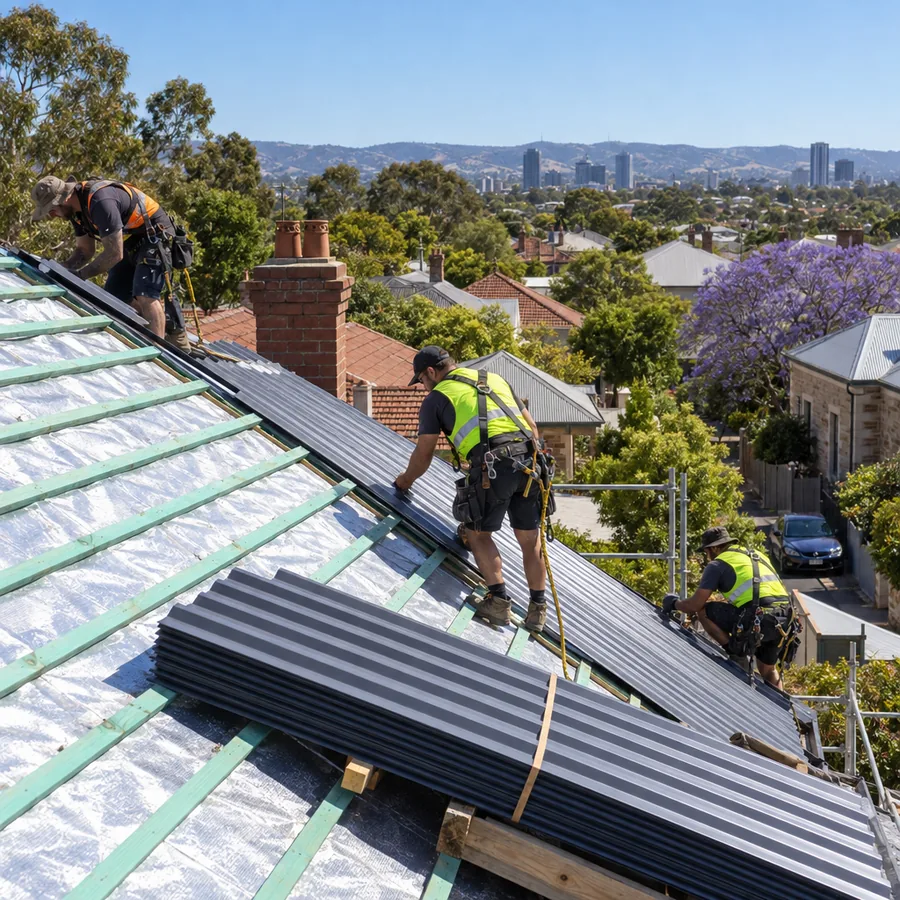
There is a point where restoring a roof stops making sense. The concrete tiles are porous across the whole roof, the battens have rotted where the sarking failed, the valleys and flashings have rusted through, and the restoration quote lists so many repairs that it is approaching the cost of a new roof that will last another fifty years. This page covers how that judgement is made, the choice between tiles and Colorbond steel, what a full replacement involves from strip-out to the last downpipe, how asbestos cement roofs are handled, what heritage overlays in the inner suburbs allow, and what determines the quote.
When a roof is past restoring
A roof restoration works when the tiles or sheets are mostly sound and the faults are on the surface. Replacement is the answer when the roof itself has failed.
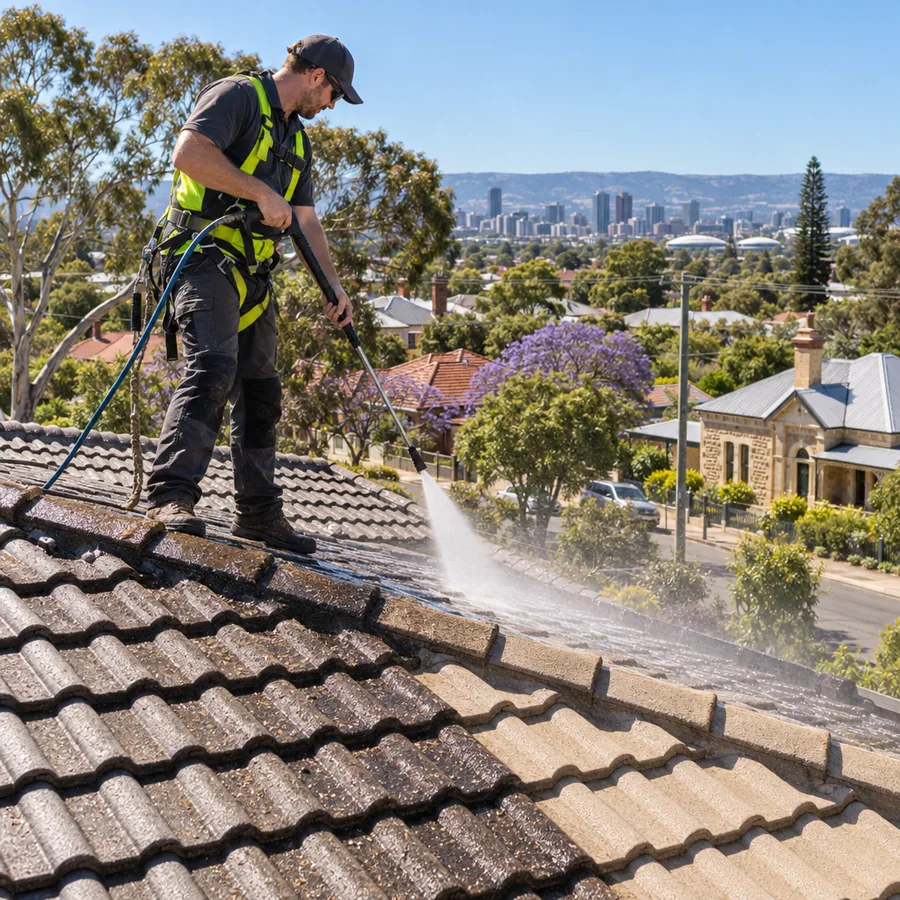
On tiled roofs that means concrete tiles from the 1960s and 1970s that have eroded through their surface across the whole roof, so that most of them are porous, cracking underfoot and holding water against the battens. It means terracotta tiles in a discontinued profile that can no longer be matched from salvage. It means sarking that was never fitted or has torn across the roof, so every windy front puts water in the ceiling somewhere new. And it means batten timber that has rotted or been eaten out, which shows as a wave in the roofline from the street.
On metal roofs it means sheets rusted through rather than surface rusted, which happens fastest along the coast from Semaphore to Glenelg where salt air attacks galvanised iron and early Colorbond. Once the sheets have holes, treating rust and coating is spending money on a roof that is finished.
The roofer will say plainly which side of the line your roof is on. A restoration that will need to be done again in five years is a poor spend compared with a new roof that will not.
Tile or Colorbond: choosing the new roof
Both are used across Adelaide and both do the job. The choice comes down to the house, the frame and the look.
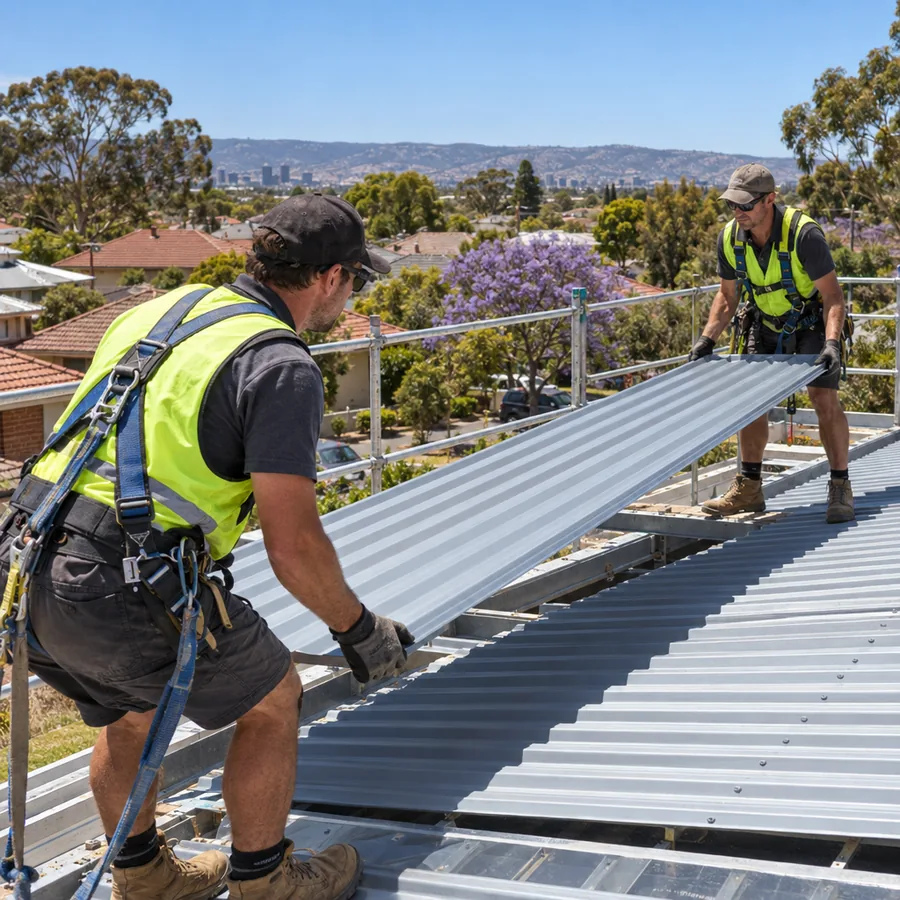
Colorbond steel is lighter than tiles, which matters on an older frame. It goes on faster, sheds water well at low pitches, comes in a wide colour range, and suits the corrugated look of the villas and cottages in North Adelaide, Unley, Norwood and Port Adelaide that were built under galvanised iron. Near the coast the roofer specifies the marine grade of steel and the right fasteners, because standard steel corrodes faster in salt air.
New terracotta or concrete tiles keep the look of a 1950s to 1980s tiled home in Mitcham, Marion or Modbury, are quiet in rain, and are easy to repair one tile at a time later on. They are heavier, so the frame must be confirmed sound, and they are slower to install.
Swapping from tiles to Colorbond is the most common change in Adelaide and is covered in detail on the re-roofing page and in the post on tile to metal roof conversions. Going the other way, from metal to tiles, usually needs an engineer to confirm the frame can carry the extra weight.
What a full roof replacement involves
The job is staged so the house is never left open overnight. Edge protection, harness anchors or scaffold go up first, as required for work at heights under SA work health and safety rules.
The old roof comes off in sections. Tiles are dropped into a skip, sheets are cut and lowered, and old ridge capping, valleys and flashings are removed. Once a section is bare the roofer can see the frame properly. Rafters are checked for rot, sag and borer, and battens are replaced wholesale on a re-tile or fitted new at the spacing the new sheeting needs.
New sarking or an insulation blanket goes on next. This is the layer most old Adelaide roofs are missing, and it is the reason a new roof is so much drier and quieter than the one it replaces. Then the new roof covering is fitted, tile by tile or sheet by sheet, with new ridge capping, valleys, barge cappings and flashings at every chimney, skylight, vent and pipe.
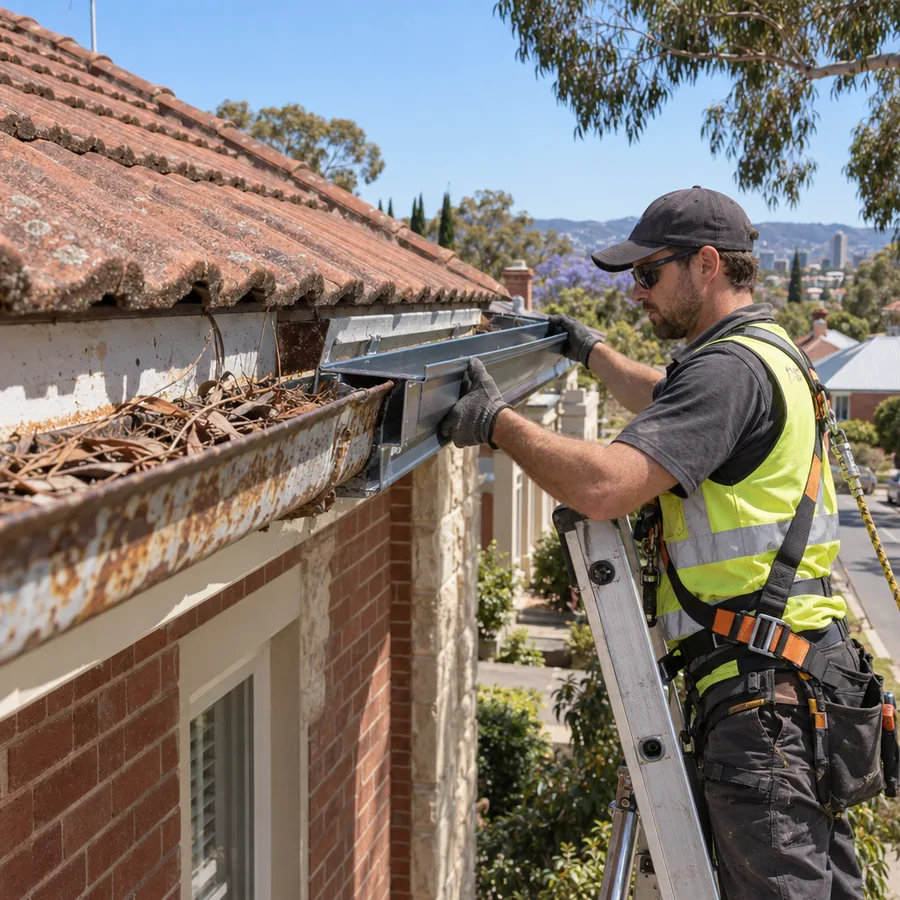
Gutters, downpipes and often fascia are replaced at the same time. There is no point hanging a new roof over gutters that are rusted or have lost their fall, and the new roof’s edge detail is designed around the new gutter profile. Solar panels are disconnected and removed by an electrician before the strip and refitted with proper flashings afterwards.
At the end, every fixing and lap is checked, the gutters are flushed, the site is cleared of old material and you receive photos and the written warranties.
Asbestos cement roofs and licensed removal
Many Adelaide homes built before the late 1980s, including the 1950s and 1960s Housing Trust homes in Elizabeth, Salisbury and pockets of the southern suburbs, were roofed in corrugated asbestos cement, often called Super Six. The sheets are safe while undisturbed and coated, but they weather, crack and become brittle, and they cannot be walked on or worked around safely once they are being removed.
Removal of anything more than a very small area must be done by a licensed asbestos removalist regulated by SafeWork SA, with the sheets wetted, wrapped and taken to a licensed disposal site. The roofer arranges the removalist as part of the replacement, and the new roof goes on once the removal is signed off. There is no do-it-yourself path for this, and a quote that does not mention asbestos on a pre-1990 fibre cement roof should be questioned.
Heritage and character areas in the inner suburbs
The bluestone and sandstone villas, cottages and bungalows of North Adelaide, Unley, Norwood, Prospect, Parkside and the older parts of Burnside often sit in heritage or character zones. These zones generally limit what can be changed on the street frontage, which for a roof means the profile and sometimes the colour visible from the street. A villa that was built under corrugated iron will usually be expected to go back to a corrugated profile, and a terracotta bungalow may be expected to stay tiled at the front.
That rarely prevents a replacement. It shapes the choice of material and profile, and the roofer will raise it before quoting so the council question is settled early. Councils vary, so this is checked case by case rather than assumed.
What drives the quote
No two roof replacements cost the same, and no figure is given here because it would be invented. What moves the quote is the roof area and pitch, the number of hips, valleys and penetrations, the material chosen and its grade, whether the frame or battens need work, whether asbestos removal is involved, the access and scaffold needed on a two-storey home or a steep Hills block, whether gutters, downpipes and fascia are included, and whether solar panels have to come off and go back on. The post on what drives a roof replacement quote in Adelaide goes through each of these. The quote you receive is written and itemised so each of those lines is visible, and nothing starts until you approve it.
Licensing, contracts and safety
In South Australia roofing is building work regulated by Consumer and Business Services. The contractor must hold a Building Work Contractors Licence, and the roof plumbing part of the job, meaning sheet metal roofing, gutters, downpipes and flashings, is licensed plumbing work. You are entitled to ask for the licence number and check it on the CBS public register. A roof replacement is normally above the value at which a written contract is required under the Building Work Contractors Act, and that contract sets out the scope, the price, the timing and the workmanship warranty. Manufacturer warranties apply to the steel or tiles used.
Replacement, re-roofing or restoration
If the roof covering has failed but the frame is sound, the job is usually described as re-roofing: a new covering on the existing frame, with new battens and sarking. If the tiles or sheets are mostly sound, a restoration is the better spend. A full replacement is the answer when the covering, the battens and often the gutters have all reached the end together. The inspection is what sorts one from the other, and the written quote states which is being recommended and why.
What is included
- Inspection of the roof, frame, battens, sarking and ceiling space to confirm replacement is the right call
- Removal and disposal of the old tiles or sheeting, with licensed asbestos removal where the roof is asbestos cement
- Frame check, new or replaced battens and new sarking or insulation blanket under the new roof
- New Colorbond steel sheeting or new terracotta or concrete tiles in the profile and colour you choose
- New ridge capping, valleys, flashings, barge cappings and penetration flashings
- New gutters, downpipes and fascia where the old ones are rusted or out of fall
- Edge protection or scaffold set up as required for work at heights
- Site clean-up, gutter flush and a final walk-over with you
Signs you should call
- Concrete tiles that are porous across the whole roof, not just a few, and cracking under any foot traffic
- Metal sheets rusted through in several places, especially on coastal homes
- Sarking torn or absent and leaks appearing in a new spot every winter
- Rotten or sagging battens, or a visible dip in the roofline from the street
- An asbestos cement roof that is cracking, weathering or being disturbed by other work
- A discontinued tile profile with no matching replacements available
- A restoration quote that lists so many repairs it is approaching the cost of a new roof
Asbestos cement roofs on pre-1990 Adelaide homes
Many Adelaide homes built before the late 1980s were roofed in corrugated asbestos cement, including 1950s and 60s Housing Trust homes in Elizabeth, Salisbury and pockets of the south. The sheets are safe while undisturbed but must not be cut, drilled or removed by anyone other than a licensed asbestos removalist regulated by SafeWork SA. The roofer arranges the removalist as part of the replacement. There is no do-it-yourself option.
Frequently asked questions
Q. How do I know if my roof needs replacing rather than restoring?
Restoration works when the tiles or sheets are mostly sound and the faults are on the surface. Replacement is the answer when the roof itself has failed: concrete tiles porous across the whole roof and cracking underfoot, metal sheets rusted through rather than surface rusted, sarking torn or absent so leaks appear in a new place every winter, rotten battens showing as a dip in the roofline, or a discontinued tile profile that cannot be matched. The inspection decides, and the roofer states which is being recommended and why on the quote.
Q. Should I replace with tiles or Colorbond?
Both are used across Adelaide. Colorbond steel is lighter, faster to fit, works at lower pitches and suits the corrugated look of the villas and cottages in the inner suburbs; near the coast the roofer specifies a marine grade and matching fasteners. New terracotta or concrete tiles keep the look of a 1950s to 1980s tiled home, are quiet in rain and are easy to repair tile by tile later, but they are heavier and slower to install. Tile to Colorbond is the most common change; going from metal to tiles usually needs an engineer to confirm the frame can carry the weight.
Q. My roof is asbestos cement. What happens to it?
It is removed by a licensed asbestos removalist regulated by SafeWork SA before the new roof goes on. The sheets are wetted, wrapped and taken to a licensed disposal site, and the new roof is fitted once the removal is signed off. The roofer arranges the removalist as part of the replacement and it appears as its own line on the quote. Nobody should cut, drill, pressure clean or remove asbestos cement themselves.
Q. Can I change the look of my roof if the house is in a heritage or character area?
Often, within limits. Heritage and character zones in North Adelaide, Unley, Norwood, Prospect, Parkside and parts of Burnside generally control what is visible from the street, so a villa built under corrugated iron is usually expected to go back to a corrugated profile and a terracotta bungalow may be expected to stay tiled at the front. That rarely prevents a replacement; it shapes the profile and sometimes the colour. Councils vary, so the roofer raises the question before quoting rather than assuming.
Q. What drives the cost of a roof replacement?
Roof area and pitch, the number of hips, valleys and penetrations, the material and its grade, whether the frame or battens need work, whether asbestos removal is involved, the access and scaffold needed on a two-storey home or a steep Hills block, whether gutters, downpipes and fascia are included, and whether solar panels have to come off and go back on. No figure is given here because it would be invented; the quote you receive is written and itemised so each of those lines is visible.
Q. How long is the house exposed during a replacement?
It is not left open. The old roof is stripped in sections that can be battened, sarked and covered the same day, so the house is weatherproof at the end of every working day. A typical single-storey home is a matter of days rather than weeks, depending on roof size, complexity, access and weather. The roofer gives you an honest timeline on the quote and watches the forecast day to day, particularly between May and September.
Q. Do I need a written contract and a licensed contractor for a new roof in SA?
Yes. Roofing is building work regulated by Consumer and Business Services, and the contractor must hold a Building Work Contractors Licence; the sheet metal, gutter, downpipe and flashing work is licensed roof plumbing. You can ask for the licence number and check it on the CBS public register. A roof replacement is normally above the value at which a written contract is required under the Building Work Contractors Act, and that contract sets out the scope, price, timing and the workmanship warranty. Manufacturer warranties apply to the steel or tiles used.