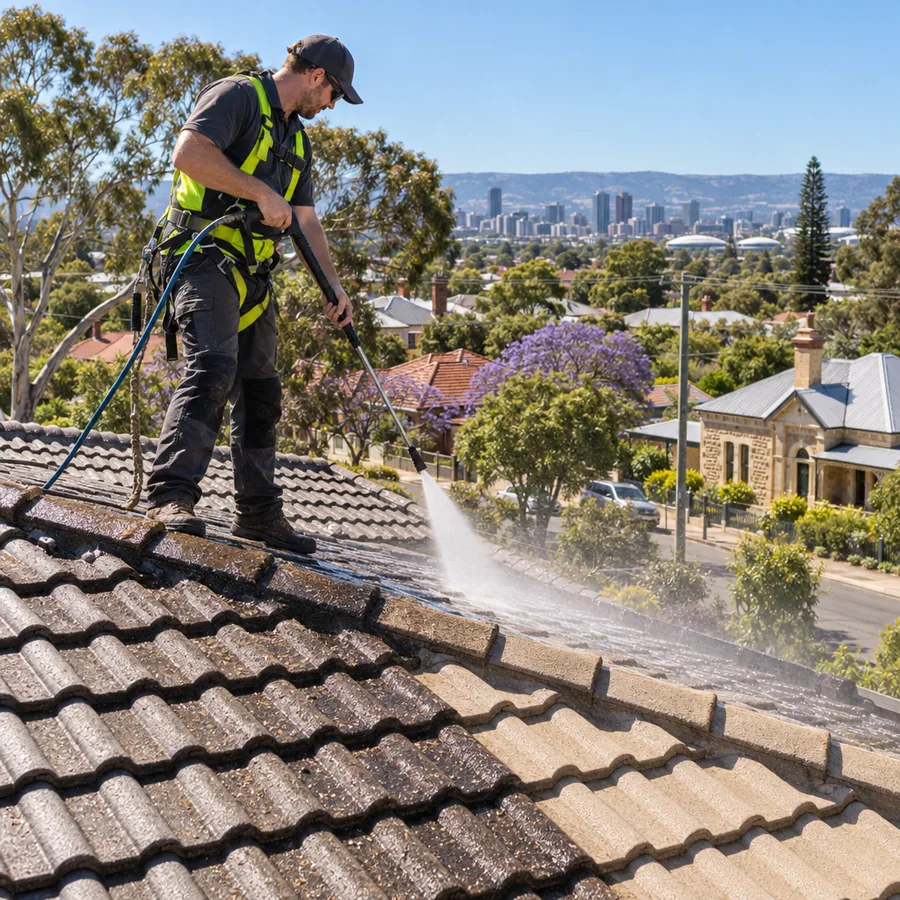
Most Adelaide roofs that get restored are between thirty and fifty years old. The concrete tiles have gone chalky, the mortar on the ridges has cracked, the valleys are rusting and the roof lets in a little water each winter. None of that means the roof is finished. A proper restoration deals with each of those faults in order and then seals the whole surface, and it is the reason so many 1960s to 1980s roofs in Mitcham, Marion, Modbury and Campbelltown are still doing their job. This page explains what a full restoration includes, how tile and metal restorations differ, when restoration is the right spend and when it is not, and what changes near the coast and up in the Hills.
What a full roof restoration includes
A restoration is a sequence of repairs with a coating at the end, not a coat of paint with a few repairs thrown in. On a tiled roof it runs like this.
The roof is high-pressure cleaned first. That strips the dirt, moss, lichen and the loose, eroded surface of old concrete tiles so the coating has something sound to hold onto. The clean also shows the roofer every hairline crack that was hidden under grime.
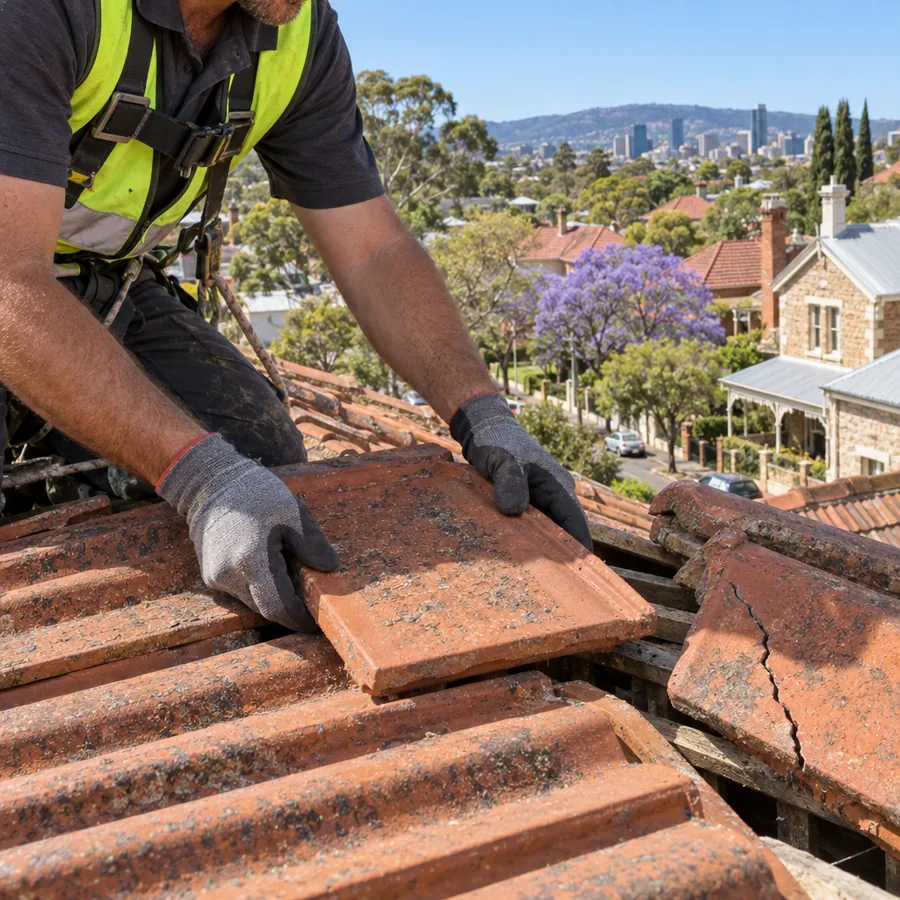
Broken, cracked and slipped tiles are replaced with matching tiles. Porous concrete tiles that are soaking up water are swapped where the count is small, and where the count is large the roofer will tell you before quoting, because at some point replacement is the better spend.
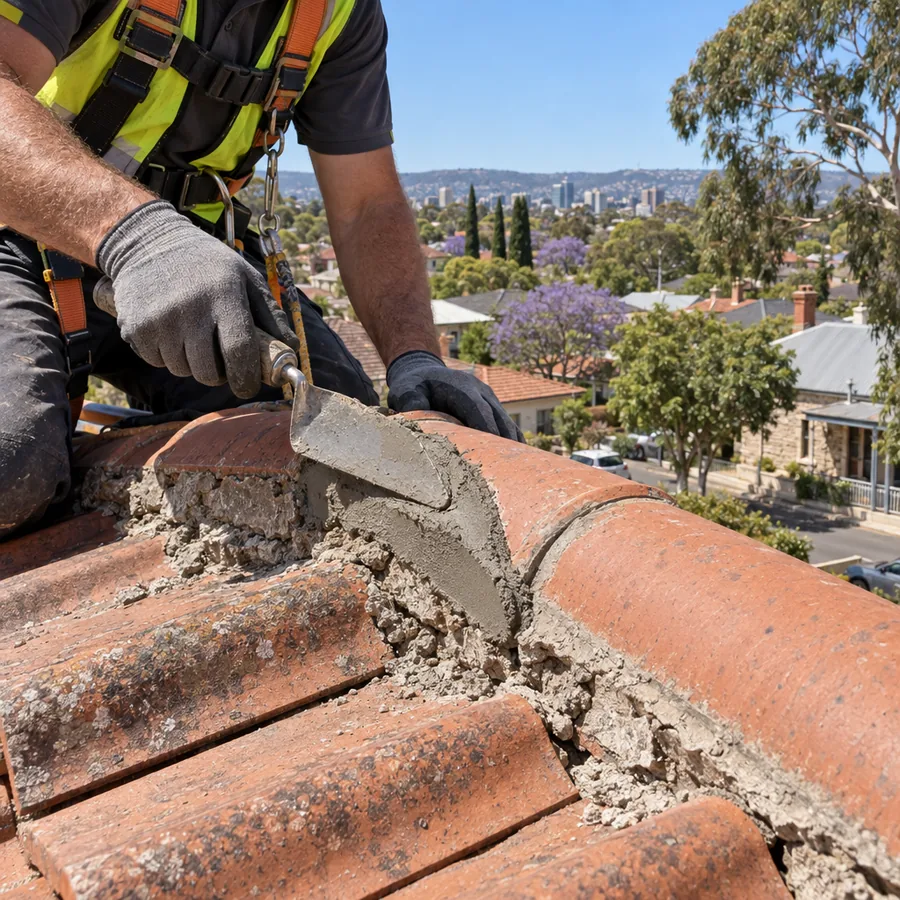
Ridge and hip capping is the heart of the job. The old cement bedding is broken out, the caps are rebedded in fresh mortar and then repointed with a flexible pointing compound that moves with the roof instead of cracking. The repointing and rebedding page covers this step in detail.
Rusted valley irons are cut out and replaced. Flashings around chimneys, skylights, whirlybirds and solar mounts are resealed or replaced, and old lead that has fatigued in the heat is renewed. The gutters are checked while the roofer is there, because a restored roof that drains into rusted gutters still puts water in the ceiling.
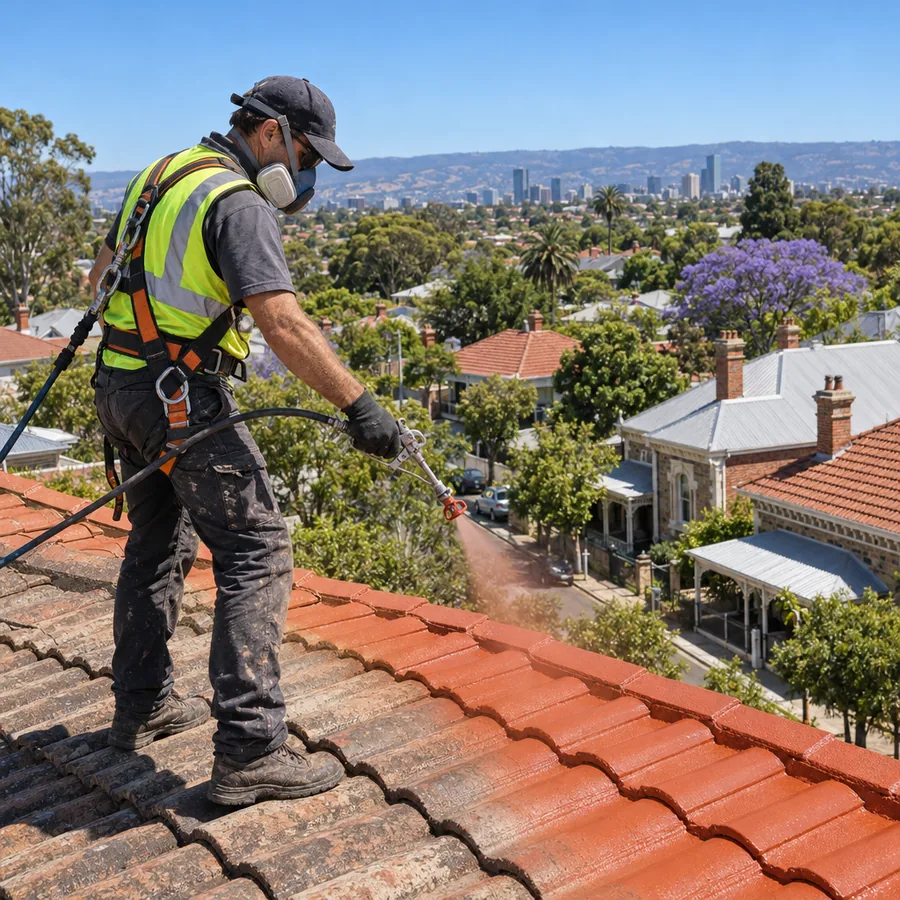
Moss and lichen are treated with a biocide so growth does not return under the coating. Then the roof is primed or sealed and given two coats of a roof membrane in the colour you choose. Two coats matter; a single coat looks fine from the street for a year and then fails.
Why Adelaide concrete tiles wear out
Concrete tiles went on most Adelaide homes built from the 1960s onward, from the brick veneers of Morphett Vale and Happy Valley to the Housing Trust estates of Elizabeth and the 1970s subdivisions of Golden Grove. A concrete tile is strong, but its coloured surface is only a thin layer. Summer heat, winter rain and UV wear that layer away over thirty to forty years, leaving a pale, rough, chalky tile that drinks water like a sponge.
A porous tile weighs more when wet, holds moisture against the sarking and battens, grows moss on the shaded southern side, and cracks more readily when a solar installer or antenna tradie walks on it. Restoration works because the tile underneath is usually still sound; sealing and coating it stops the erosion and returns it to shedding water.
Terracotta tiles on interwar bungalows in Unley, Prospect and Norwood behave differently. The fired clay does not go porous in the same way, so a terracotta restoration is mostly about the ridges, valleys, flashings and broken tiles, and coating is often left off. The roofer will say which applies to your roof.
Ridge mortar, heat and the clay under the house
Ridge and hip caps on pre-2000 Adelaide roofs sit on a bed of cement mortar with a mortar pointing finish. Cement mortar is rigid. Adelaide roofs expand on 40 degree days and contract on cold winter nights, and the reactive clay under much of the plain swells with winter rain and shrinks in summer, moving footings, walls and roof frames a small amount every year. Rigid mortar cannot follow that movement, so it cracks, then crumbles, then lets water under the caps, and a spring northerly finishes the job by lifting a loose cap off the roof.
This is why almost every restoration in Adelaide includes a full rebed and repoint, and why the pointing is done with a flexible compound. It is also why coating a roof without touching the ridges is money wasted: the coating bridges the crack for one summer and opens again with the next.
Tile roof restoration versus metal roof restoration
Tile restoration is the sequence above. Metal roof restoration on galvanised iron, Zincalume and older Colorbond follows the same logic with different steps. The roof is cleaned, rust is treated and converted, corroded or backed-out screws are replaced with new fasteners and fresh seals, sheet laps and penetrations are sealed, badly rusted sheets are swapped, and then the roof is primed and coated. Any metal roof repairs the inspection finds, such as lifted sheets or rusted-through gutters, are quoted as part of the job.
Metal restoration makes sense when the sheets are surface rusted but not perforated. Once sheets have rusted through in several places, particularly along the coast, re-sheeting is the better answer and the roofer will say so.
When restoration beats replacement, and when it does not
Restoration is the right call when the tiles or sheets are mostly sound, the roof frame is straight, the sarking is intact or can be patched from above, and the faults are the usual ones: worn surface, cracked pointing, rusted valleys, a handful of broken tiles. That describes most 1960s to 1990s roofs in the southern, northern and eastern suburbs.
It is the wrong call when concrete tiles are so porous that a large share need replacing, when the batten timber is rotten, when the sarking has failed across the roof and every heavy front puts water in the ceiling, or when the tile profile is discontinued and no salvage stock exists. At that point the money is better spent on re-roofing or a full replacement. A restoration quote should say plainly which side of that line your roof sits on. The blog post on what drives the cost of a roof restoration in Adelaide explains how the two compare.
Coastal suburbs and the Adelaide Hills
Along the coast from Semaphore through Grange and Henley Beach to Glenelg, salt air corrodes valley irons, flashings, screws and gutters well before the tiles wear out. Restorations here lean heavily on new metal work, and the roofer specifies fasteners and flashings suited to a marine environment.
In the Hills, from Blackwood and Belair up to Stirling, Aldgate and Hahndorf, the problems are rain and shade. Higher rainfall, stringybark leaf litter and cool south-facing slopes grow moss and lichen thickly, and gutters and valleys block. Hills restorations include a thorough biocide treatment, often gutter guards, and in bushfire-prone areas the roofer works within the Bushfire Attack Level requirements for the property. The Adelaide Hills service area page has more on Hills roofs.
Coating without the repairs is painting, not restoration
A cheap roof coating over an unrepaired roof is a cosmetic job. It hides cracked pointing, porous tiles and rusted valleys for a season and then the leaks return with the coating peeling off around them. If you only want colour on a roof that has already been repaired, the roof painting page covers that. If the roof has not been repaired in twenty years, it needs a restoration, and the quote will be itemised so you can see exactly what is being fixed before any coating goes on.
Getting a restoration quoted
The roofer inspects the roof and the ceiling space, photographs what they find, and writes an itemised quote covering the clean, the tile count, the metres of ridge and hip, the valleys and flashings, the treatment and the coating system, with the workmanship warranty stated in writing. Manufacturer warranties apply to the coating and products used. Work is timed for dry weather, which in Adelaide usually means outside the wettest weeks of June to August, and nothing starts until you approve the quote. You can ask for the roofer’s CBS Building Work Contractors Licence number and check it on the public register before work begins.
What is included
- Full roof inspection with photos of every ridge, valley, flashing and damaged tile before anything is quoted
- High-pressure clean to strip dirt, moss, lichen and the eroded surface of old concrete tiles
- Replacement of cracked, slipped and porous tiles with matching profiles, and of rusted screws on metal roofs
- Ridge and hip capping rebedded in fresh mortar and repointed with a flexible pointing compound
- Rusted valley irons and fatigued flashings replaced, laps and penetrations sealed
- Moss and lichen treatment so growth does not return under the new coating
- Primer or sealer followed by two coats of roof membrane in the colour you choose
- Gutters cleared of the debris the clean produces and the site left tidy
Signs you should call
- Concrete tiles that look chalky, pale or rough, with the surface crumbling when touched
- Cracked or missing mortar on ridge and hip capping, or a cap that has moved in the wind
- Moss, lichen or dark streaks on the shaded side of the roof
- Rust showing on valley irons, screw heads or the laps of a metal roof
- A roof that looks patchy from the street with different-coloured replacement tiles
- Small leaks appearing after each winter front, in a different place each time
- A pre-2000 roof that has never been restored and is now being asked to last another twenty years
Coating a roof without repairing it first is painting, not restoration
A membrane coating over cracked pointing, porous tiles and rusted valleys hides the faults for a season and then peels off around the leaks. Ask any restoration quote to list the rebed and repoint, the valley and flashing work and the tile count before the coating. If those lines are missing, the price is for a paint job.
Frequently asked questions
Q. What does a roof restoration in Adelaide actually include?
A full tile roof restoration is a high-pressure clean, replacement of cracked, slipped and porous tiles, rebedding and repointing of all ridge and hip capping with a flexible pointing compound, replacement of rusted valley irons and failed flashings, a moss and lichen treatment, and then a primer or sealer followed by two coats of roof membrane. On a metal roof the repairs are rust treatment, new screws and sealed laps before the coating. The quote is itemised so each of those steps is visible.
Q. Is restoration better than replacement for my roof?
Restoration is the right spend when the tiles or sheets are mostly sound, the frame is straight and the faults are on the surface: worn tiles, cracked pointing, rusted valleys, a handful of broken tiles. It is the wrong spend when most concrete tiles are porous, the battens are rotten, the sarking has failed across the roof or the tile profile cannot be matched. The inspection decides, and the roofer will tell you which side of the line your roof is on before quoting.
Q. Why do the ridge caps on Adelaide roofs crack so often?
Ridge and hip caps on pre-2000 roofs sit in rigid cement mortar. Adelaide roofs expand on 40 degree days and contract on cold nights, and the reactive clay under much of the plain moves footings and roof frames slightly every year as it swells in winter and shrinks in summer. The mortar cannot follow that movement, so it cracks and crumbles, water gets under the caps and a gusty northerly lifts them. Rebedding and repointing with a flexible compound is the fix, and it is part of every proper restoration.
Q. Can a metal or Colorbond roof be restored, or only tiles?
Metal roofs are restored too. Galvanised iron, Zincalume and older Colorbond roofs are cleaned, surface rust is treated, corroded and backed-out screws are replaced with new fasteners and seals, laps and penetrations are sealed, badly rusted sheets are swapped, and the roof is primed and coated. Restoration suits a metal roof that is surface rusted but not perforated. Once sheets have rusted through in several places, particularly along the coast, re-sheeting is the better answer.
Q. How long does a roof restoration take and what weather stops it?
Most single-storey restorations run over several days: the clean and repairs first, then the coating once the roof is dry. The coating cannot go on in rain, on a wet roof, in very high heat or in strong wind, so the roofer plans around the forecast and will pause on days above 40 degrees or when a front is due. Work is usually easier to schedule outside the wettest weeks of June to August. You are given an honest timeline on the quote and updated if the weather moves it.
Q. Will a restoration fix a leaking roof?
Usually, because the repairs that make up a restoration are the same ones that stop most leaks: cracked pointing, rusted valleys, failed flashings and broken tiles. The roofer traces any active leak to its source during the inspection and makes sure the cause is on the quote. A restoration that leaves the leak unrepaired under a new coating would fail within a year, which is why the repairs come first and the coating last.
Q. Does restoration work differently near the coast or in the Adelaide Hills?
Yes. Along the coast from Semaphore through Henley Beach to Glenelg, salt air corrodes valleys, flashings, screws and gutters before the tiles wear out, so coastal restorations involve more metal work and marine-grade fasteners. In the Hills, from Blackwood and Belair up to Stirling and Hahndorf, higher rainfall, shade and leaf litter mean heavy moss and lichen, blocked valleys and gutters, and Bushfire Attack Level requirements on bushfire-prone properties. The inspection and the quote are adjusted for where the house is.